













Vegan Cocoa Powder: How to Verify Labels, Additives and Cross-Contamination Before You Buy
Cocoa powder comes from a plant, so most buyers assume every bag on the market is vegan. The assumption holds for pure, single-ingredient powder. It stops holding the moment cocoa is blended into a drink mix, flavored with an additive of unclear origin, or packed on a line that also handles dairy. For a food manufacturer building a plant-based product line, each of those cases carries labeling and compliance consequences.
The checks are not complicated, but they have to happen before the purchase order, not after a complaint. Three layers decide whether a cocoa powder is genuinely vegan: the ingredient list on the label, the additives that processing may introduce, and the production environment behind the bag.
This guide works through all three layers. It explains when cocoa powder is vegan by default, which additives change that status, what "may contain milk" statements actually mean, and how to verify a supplier's vegan claim when you buy in bulk.
Is Cocoa Powder Vegan?
Yes. Pure cocoa powder is vegan. It is made from one ingredient: cocoa beans that are roasted, ground into liquor, pressed to remove most of the cocoa butter, and milled into powder. No animal-derived substance is required at any step, and this applies to natural, Dutch-processed and black cocoa powder alike.
Cocoa powder is vegan when the ingredient list contains one entry, cocoa. Cocoa powder stops being vegan when the product is a blend that includes milk powder, whey, casein or egg-derived additives, or when a buyer's standards rule out any contact with shared dairy equipment.
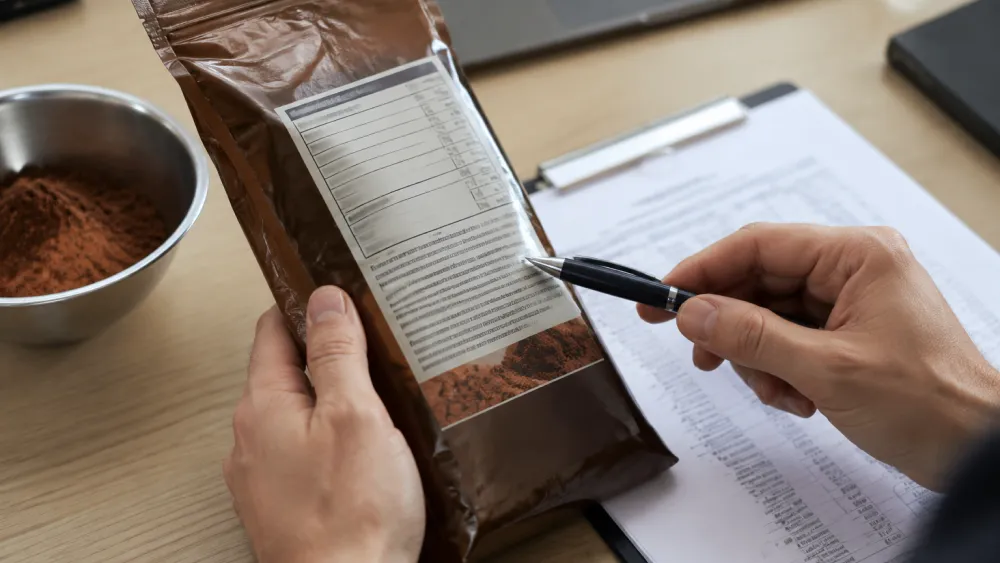
The distinction matters because the market sells both types under similar packaging. A tin labeled "cocoa" can be pure powder or a sweetened drink mix with 30% dairy ingredients. The front of the package will not tell you which one you are holding. The ingredient list will.
When Is Cocoa Powder Not Vegan? Additives to Watch
Problems begin where pure powder ends. Once a manufacturer blends cocoa with other ingredients to build a flavored product, animal-derived components can enter the formula. Three groups account for nearly all cases.
Milk-Based Ingredients in Cocoa Mixes
Hot cocoa mixes and instant chocolate drinks are the largest category. Typical formulas add milk powder, whey, casein, buttermilk solids or non-dairy creamer that itself contains sodium caseinate, a milk protein. Despite the name, "non-dairy" creamer is not always free of milk derivatives. In most regulated markets, milk is a priority allergen and must be declared, so these ingredients appear on the label, sometimes only inside the allergen statement.
Lecithin and Emulsifiers
Some cocoa products and chocolate coatings include lecithin as an emulsifier. Soy and sunflower lecithin are plant-based. Lecithin can also be derived from egg yolk, which is not vegan. When the label only says "lecithin" without a source, the origin is unclear. Products carrying a recognized vegan certification mark use plant sources; uncertified products require a question to the manufacturer.
Flavorings, Sweeteners and Processing Aids
Flavor systems can contain dairy-derived carriers or honey. Refined sugar in some regions is processed with bone char, which concerns strict vegans even though no animal material remains in the sugar itself. These edge cases rarely appear in plain cocoa powder, but they appear often enough in flavored and sweetened cocoa products to justify a label check every time.
| Ingredient on label | Common source | Vegan status |
|---|---|---|
| Cocoa / cocoa powder | Cocoa beans | Vegan |
| Cocoa processed with alkali | Cocoa beans plus mineral alkalizing salts | Vegan |
| Soy or sunflower lecithin | Plant | Vegan |
| Lecithin (source not declared) | Plant or egg yolk | Unclear; verify with manufacturer |
| Milk powder, whey, casein, buttermilk | Dairy | Not vegan |
| Sodium caseinate ("non-dairy" creamer) | Milk protein | Not vegan |
| Honey, milk-based flavor carriers | Animal-derived | Not vegan |
Is Dutch-Process (Alkalized) Cocoa Powder Vegan?
Yes. Alkalization raises the pH of cocoa by treating the nibs, liquor or cake with an alkaline solution, most commonly potassium carbonate. Potassium carbonate is a mineral salt, not an animal product. The process changes color, flavor and solubility; it adds no animal-derived material. A Dutch-processed powder is as vegan as a natural one.
Buyers sometimes suspect alkalized cocoa because the darker color and smoother taste resemble chocolate products that do contain dairy. The resemblance is sensory only. For the differences in pH, color and application between the two processes, see our article on natural vs Dutch-process cocoa powder.
Cross-Contamination: What "May Contain Milk" Really Means
Labels such as "may contain milk" or "produced in a facility that also handles dairy" describe shared equipment, not recipe ingredients. The product formula is vegan; the warning exists because trace contact cannot be excluded on a line that also runs dairy products.
How much this matters depends on the buyer. Most vegan consumers accept trace-risk products. Strict certification programs, allergen-sensitive markets and brands with "free from" claims often cannot. For a manufacturer selling a certified vegan finished product, the practical question is not whether the powder contains milk but whether the supplier's facility can document that dairy never enters the process.
This is where the production model of the supplier becomes the deciding factor. Facilities that fall into three groups carry different risk levels:
Chocolate and confectionery plants that run milk chocolate on shared lines present the highest contact risk.
Blending and repacking operations that handle drink mixes alongside pure powder can introduce contact during changeovers.
Dedicated cocoa processing plants that handle only cocoa beans and cocoa derivatives carry no dairy contact risk, because no dairy ingredient enters the site.
Wuxi Huanda Cocoa Food Co., Ltd. belongs to the third group. Our factories in Cambodia, China and Indonesia process cocoa beans into cocoa powder, cocoa butter and cocoa liquor, and nothing else. No dairy or animal-derived ingredient is processed, blended or packed on our lines, so cross-contact with milk is excluded by the product scope of the plants themselves. Allergen management still operates under our FSSC 22000 food safety system, which means the control is documented and audited rather than assumed.
Vegan Certifications and Ethical Sourcing
A vegan claim can be self-declared or certified. Self-declaration costs nothing and means whatever the seller intends it to mean. Certification adds an external audit. Three marks cover most of the market:
The Vegan Society Vegan Trademark, the oldest scheme, audits ingredients, processing aids and cross-contamination controls.
Vegan Action (Certified Vegan), common on North American products, verifies that no animal ingredients or animal testing are involved.
V-Label, administered across Europe, certifies vegan and vegetarian products with similar ingredient and process reviews.
For bulk buyers, certification is a shortcut, not a substitute for documentation. A certificate confirms status at audit time; the purchase still needs a batch-level paper trail. The documents that matter are the specification sheet, the allergen statement, and the certificate of analysis (COA) for the shipped batch.
Many vegan buyers also weigh the ethics behind the bean. Cocoa farming in West Africa has documented labor problems, and certifications such as Fairtrade address the social side of sourcing. We covered the organic angle in our organic cocoa powder guide and the labor and pricing angle in our Fairtrade certification article. Our own range carries FSSC 22000, Halal and Non-GMO certification, with beans sourced from Côte d'Ivoire and Ghana under full traceability to our processing lines.
Choosing Vegan Cocoa Powder for Baking and Beverage Production
Once vegan status is settled, selection follows the application. The variables that decide performance are fat content, pH and color, and all of them are independent of the vegan question.
| Application | Recommended type | Why |
|---|---|---|
| Vegan cakes and brownies | Natural or lightly alkalized, 10-12% fat | Clean flavor release; works with baking soda systems |
| Dark vegan cookies and sandwich biscuits | Alkalized or black, pH 7.0-9.0 | Deep color and mellow flavor without dairy-based flavor carriers |
| Plant-based chocolate drinks | Alkalized, fine grind (99% through 200 mesh) | Better dispersion in oat, soy and nut milk bases |
| Vegan ice cream and desserts | 10-12% or 4-8% fat grades | Fat level adjusted to the recipe's own fat system |
Our production covers 16 cocoa powder varieties spanning natural, alkalized and black types, fat grades at 10-12% and 4-8%, and a pH range from 5.0 to 9.0, all milled to 99% minimum through 200 mesh. The full specifications are listed on our bulk cocoa powder page.
Sourcing Vegan Cocoa Powder in Bulk: 5 Questions for Your Supplier
Retail buyers read a label. Bulk buyers verify a supply chain. Five questions establish whether a supplier's vegan claim will survive your own audit:
What does the ingredient declaration on the specification sheet say? One ingredient, cocoa, is the only answer that closes the question. The spec sheet, not the marketing page, is the contractual document.
Does the facility handle any dairy or animal-derived ingredients? A dedicated cocoa plant removes the cross-contact question entirely. A shared facility should document changeover and cleaning controls.
Which certifications cover the product, and what is their scope? FSSC 22000 covers the food safety system; Halal and vegan marks add ingredient-level assurance. Ask for the certificate scope, not just the logo.
Can you provide a batch COA before shipment? The COA confirms composition values for the exact lot you will receive, including fat, moisture, pH and microbiology.
Can you send a sample with the spec sheet and COA? A supplier confident in its product has no reason to refuse a testable sample.
As a reference point, our own practice answers all five: single-ingredient declarations for every grade, dedicated cocoa-only production with no dairy on site, FSSC 22000 with Halal and Non-GMO certification, batch COA issued for each order, and free samples with full documentation. Standard packaging is 25 kg kraft paper bags with PE liner, shelf life is 24 months, lead time runs 15-25 days, and we ship to more than 62 countries. The standard minimum order is one 20-foot container, negotiable for first orders.
The fastest way to verify a vegan claim is to test the product yourself. Review our cocoa powder specifications and request free samples with the batch COA. The documentation will tell you more than any label.
FAQ