













What Is Cocoa Liquor (Cocoa Mass)? Definition, Production, and Its Role in Chocolate
Cocoa liquor, also called cocoa mass or chocolate liquor, is roasted cocoa beans ground into a fluid paste containing both cocoa butter and cocoa solids. It is the base ingredient of chocolate, providing its characteristic flavor and much of its fat structure. For food manufacturers, its fat content, fineness, pH, and flavor consistency determine how the chocolate recipe is built.
This article explains how cocoa liquor is produced, how it compares with cocoa butter and cocoa powder, and which specifications and supplier checks matter when you buy it in bulk.
What Is Cocoa Liquor (Cocoa Mass)?
The three names refer to the same product, but they belong to different contexts. Cocoa mass is common in Europe and on many specification sheets, chocolate liquor is the official term in US food standards and labeling, and cocoa liquor is widely used in international trade. Cocoa paste appears occasionally with the same meaning.
The naming differences do not signal different grades or formulas. A certificate of analysis that says cocoa mass and an ingredient list that says chocolate liquor can describe the same lot. Buyers should check the composition and specifications—ground cocoa beans with their natural fat intact—rather than read quality into one name.
Does Cocoa Liquor Contain Alcohol?
No. Cocoa liquor contains zero alcohol, and the name is a vocabulary problem rather than a recipe problem. “Liquor” here carries the older English meaning of “liquid” or “fluid,” describing the molten state of the ground beans during processing. The product is 100% cocoa.
Two things get confused with it. Chocolate liqueur is an alcoholic drink flavored with cocoa, and liquor-filled chocolates are pralines with a small alcoholic center. Neither has anything to do with cocoa liquor as an ingredient, and this article does not cover them.
The no-alcohol point also has a compliance side. Our cocoa liquor is Halal certified, and that certification requires the ingredient and its production process to be free of alcohol. For buyers formulating for Halal markets, the certificate covers the concern on paper, not only in wording.
How Is Cocoa Liquor Made?
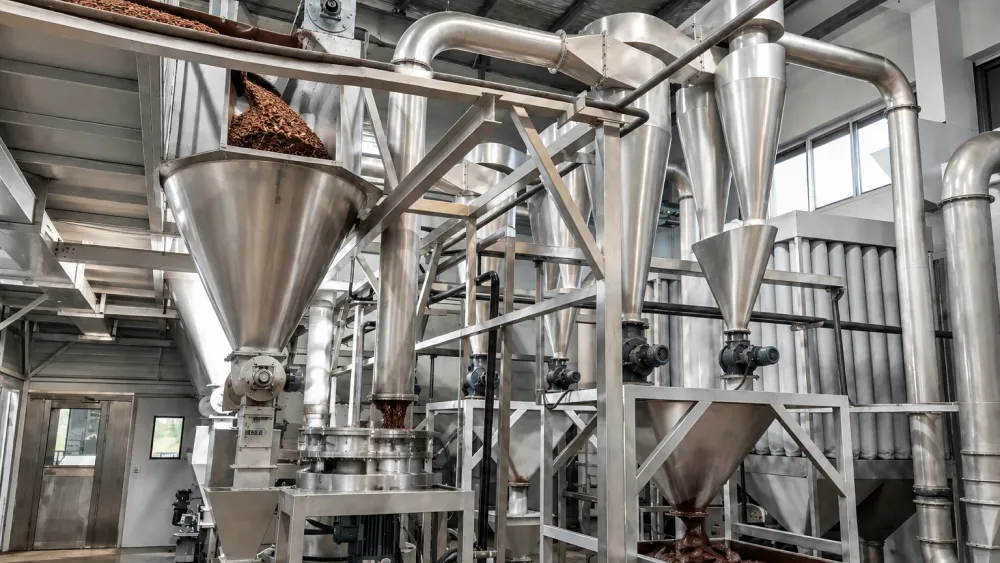
Industrial production follows the sequence documented by the International Cocoa Organization in its cocoa processing overview. From fermented beans to blocked liquor, the line runs through seven stages:
Fermentation and drying
Cleaning
Roasting
Cracking and winnowing
Nib grinding
Optional alkalization
Cooling and blocking
1. Fermentation and drying
At origin, fresh beans are fermented for several days and then dried to a safe storage moisture. Fermentation builds the flavor precursors that roasting will later develop, and a badly fermented lot cannot be repaired by any downstream step. Our incoming beans are mainly Forastero lots from Côte d’Ivoire and Ghana, the same origins behind most of the world’s commercial chocolate.
2. Cleaning
Beans arrive with stones, dust, and shell fragments from the farm. Destoners, screens, aspirators, and magnets remove them before processing, because foreign material damages grinders and can end up in the liquor.
3. Roasting
Roasting develops chocolate flavor through Maillard reactions and loosens the shell for cracking. Each producer sets a roast curve against a flavor target for the liquor, and that curve is a large part of what distinguishes one supplier’s product from another’s.
4. Cracking and winnowing
Roasted beans are cracked, and a stream of air separates the light shell from the dense nib. Shell left in the nibs adds harsh, woody notes; nib carried away with the shell is direct yield loss.
5. Nib grinding
Nibs are roughly half cocoa butter. Passing through a series of mills, from coarse to fine, the friction generates heat, the butter melts, and the particles refine into the fluid paste known as cocoa liquor. The fineness achieved here matters downstream: coarse liquor forces longer refining in chocolate production and can leave a gritty edge, while fine liquor gives conching a head start and supports a smoother finished bar.
6. Optional alkalization
Some producers treat the nibs or the liquor with an alkaline solution to raise the pH, deepen the color, and soften the acidity. Natural cocoa liquor skips this step. The section below on natural versus alkalized liquor covers what the choice changes.
7. Cooling and blocking
The finished liquor is poured into molds and cooled into solid blocks or chunks for storage and shipment. From here it goes to chocolate plants, or onward to pressing — the first stage of the cocoa powder production process, where the liquor is split into butter and cake.
Cocoa Liquor vs Cocoa Butter vs Cocoa Powder
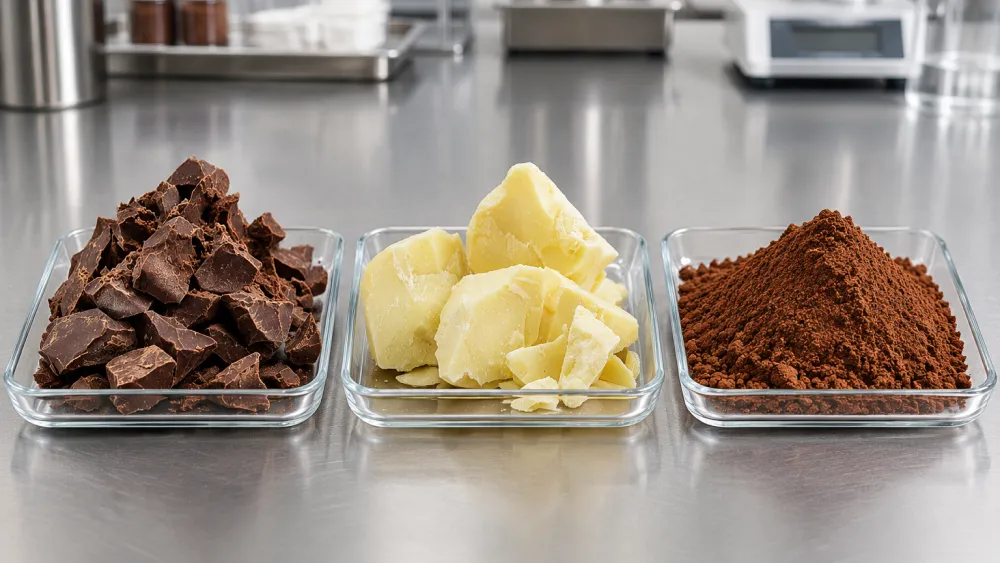
These three products come from the same processing chain, and cocoa liquor is the mother product: press it, and it splits into the other two.
| Product | What it is | Fat content | Primary use |
|---|---|---|---|
| Cocoa liquor | Whole ground cocoa beans, nothing removed | About 50–55% | Chocolate manufacturing base |
| Cocoa butter | The fat pressed out of liquor | Nearly 100% fat | Chocolate texture, cosmetics, pharmaceuticals |
| Cocoa powder | The press cake, milled and sifted | 10–12% standard; 20–24% high-fat | Beverages, baking, ice cream, confectionery |
For procurement this chain has a practical consequence: the three product lines are price- and specification-linked. Cocoa butter is usually the most valuable stream, so butter market prices move the economics of liquor and powder with it. When butter runs high, grinders press harder and standard powder grades trend toward the lean end; the fat figure in a liquor or powder specification is set against that background. Buyers who understand the relationship read a supplier’s quote more accurately and ask sharper questions about pressing parameters.
Why Is Cocoa Liquor Essential in Chocolate Manufacturing?
Chocolate starts from cocoa liquor. Sugar, extra cocoa butter, and milk solids are added to it, but the liquor itself supplies the flavor compounds and the cocoa solids that make the product chocolate rather than sweet fat.
Dark chocolate. Liquor is the primary base; the recipe adds sugar and cocoa butter.
Milk chocolate. Liquor is combined with milk solids and sugar, and its natural acidity pairs well with dairy.
White chocolate. Contains no liquor at all — it is built on cocoa butter alone, which is the clearest proof that liquor, not butter, carries the chocolate flavor.
The cocoa percentage on a retail bar counts cocoa mass plus any added cocoa butter together. A 70% dark bar might, for example, draw its cocoa from roughly 40% liquor and 30% added butter, and two bars at the same percentage can taste very different because their liquor-to-butter ratios differ.
A question that circulates among consumers is whether “chocolate liquor” on an ingredient list signals a cheap product. It does not. Liquor is the standard intermediate of the industry, used by mass-market and premium makers alike. Quality differences come from bean origin, fermentation, roasting, and grinding — from how the liquor was made, not from the fact that it appears on the label.
Natural vs Alkalized Cocoa Liquor
Alkalization (the Dutch process) treats the nibs or the liquor with an alkaline solution. It changes three properties a buyer cares about:
| Property | Natural | Alkalized |
|---|---|---|
| pH | 5.0–5.8 | Higher, depending on treatment |
| Flavor | Full cocoa character with mild acidity | Smoother, less acidic; heavy treatment strips some aroma |
| Color | Warm brown | Deeper, darker brown |
| Typical use | Standard chocolate manufacturing | Dark-colored or mild-flavored applications |
Natural liquor is the default starting point in chocolate manufacturing because it preserves the original flavor of the bean. Huanda Cocoa currently supplies natural cocoa liquor at pH 5.0 to 5.8, which works as a neutral flavor base for most chocolate recipes. For a full treatment of how alkalization changes cocoa ingredients, see our guide to natural vs Dutch-process cocoa.
What Specifications Matter When Buying Cocoa Liquor?
A liquor spec sheet is short, and every line on it translates into something your production team will feel:
| Parameter | Huanda benchmark | What it means for buyers |
|---|---|---|
| Fat content | Min. 50% | Sets how much extra cocoa butter the recipe needs; a stable figure means no recalculation between batches |
| pH | 5.0–5.8 | Confirms a natural, non-alkalized product with the expected acidity and flavor balance |
| Free fatty acids (FFA) | ≤1.75% | Proxy for bean freshness and handling; high FFA signals oxidation and off-flavors that survive into finished chocolate |
| Fineness | ≥98% | Controls refining load and mouthfeel; coarse liquor costs conching time and can leave grit in the bar |
| Moisture | <3% | Excess moisture complicates conching and storage and shortens shelf life |
Two reading tips. First, treat FFA as a freshness audit: it rises when beans are old, poorly dried, or badly stored, and no processing step can lower it afterward. Second, fineness belongs in the contract, not only in the brochure: a liquor that arrives coarser than agreed shows up on your refiner’s energy bill and in the texture of the finished product.
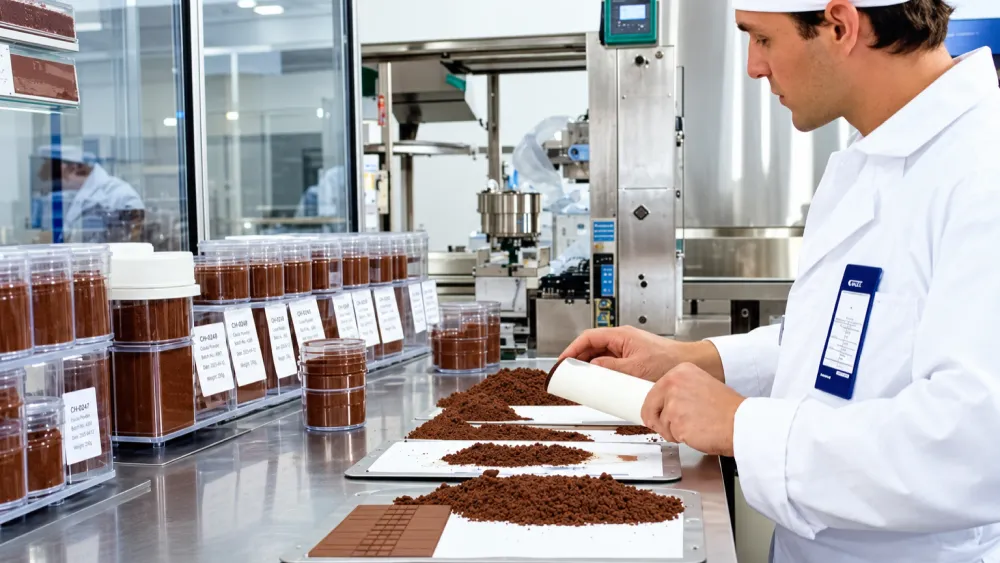
Numbers only help when they are verified lot by lot. Every Huanda batch is tested in our in-house lab for fat, pH, FFA, fineness, and moisture before it ships, and the COA that travels with the order reflects the measured values of that specific batch.
How to Evaluate a Cocoa Liquor Supplier
Switching liquor suppliers means re-testing recipes and risking drift in the finished product, so verification before the first order matters. What you can actually check:
Bean origin and flavor consistency. Ask which origins the liquor is built from and whether the blend is controlled. West African Forastero beans deliver the full-bodied, balanced profile most commercial chocolate is built on, and a controlled supply keeps the tenth container tasting like the approved sample.
Batch-level COA. A certificate of analysis per shipment, with tested values, is a different document from a generic spec sheet.
Certifications. FSSC 22000 for the food safety system, plus Halal, Kosher, and Non-GMO where your markets require them.
Form and packaging. Liquor ships as solid blocks or chunks; confirm the format fits your melting setup.
Storage and shelf life. Sealed, cool, dry storage below 25°C, away from odors; 24 months of shelf life under proper conditions.
Lead time. 15 to 25 days after order confirmation is a workable export benchmark.
Export documentation. Phytosanitary certificates, origin declarations, and fumigation reports handled on the supplier’s side; experience shipping to 62+ countries removes most paperwork surprises.
You can see how these points land on a real product page in our cocoa liquor specifications.
FAQ