













Cocoa Powder Production: Process Steps, Quality Control, and What Buyers Should Check
Cocoa powder begins as a byproduct decision. Press cocoa liquor to extract its butter, and the compacted cake left behind becomes the powder that flavors drinks, baked goods, and confectionery worldwide. How that cake is made, and what happens to the beans before pressing, decides nearly every property a buyer later measures.
This article follows cocoa powder production step by step, from bean cleaning to the sealed 25 kg bag. It explains where the process splits into natural and alkalized routes, how pressing sets the fat content, and which process parameters belong in a purchase specification. The perspective is from the production side: Huanda Cocoa runs this process on West African beans at its own facilities, so the details below reflect daily plant practice.
What cocoa powder is
Cocoa powder is the dry, fine-milled solid that remains after cocoa liquor is pressed to remove most of its cocoa butter. Cocoa liquor itself is roasted cocoa beans ground to a fluid paste. Pressing splits that paste into two products: the butter leaves as a separate ingredient, and the remaining press cake is milled into powder. The powder carries the color, the flavor compounds, and the cocoa solids, which is why it delivers chocolate character without adding much fat.
For a food manufacturer this separation is the whole point of the ingredient. Using cocoa powder instead of chocolate or liquor lets a formula control fat level, flavor intensity, and color independently. Pure natural cocoa powder contains one ingredient: cocoa. Alkalized versions add only an alkaline processing aid, which the section on production routes below covers in detail.
How is cocoa powder made: the 8-step production process
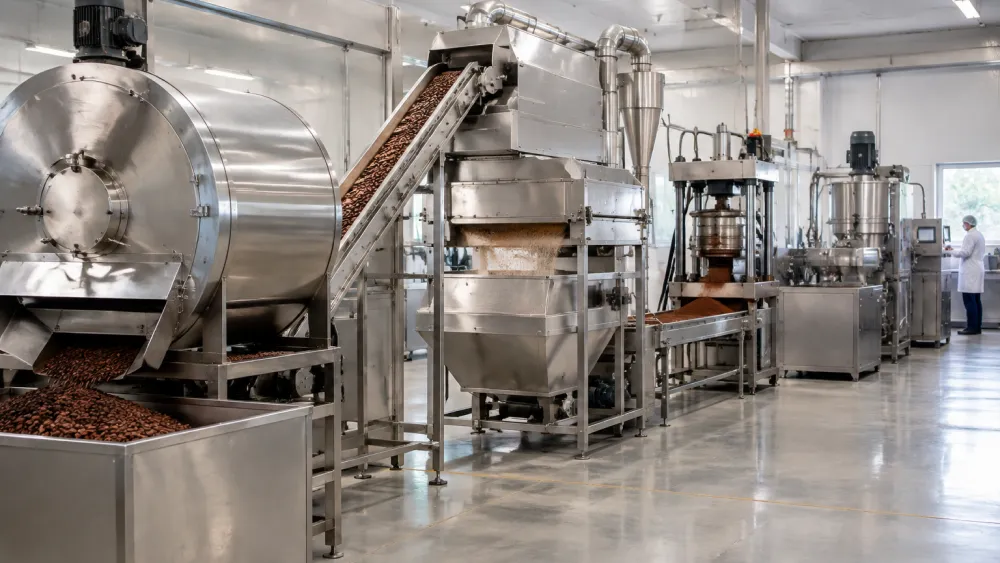
Industrial cocoa powder production follows the same backbone worldwide, and the International Cocoa Organization documents the standard sequence in its processing overview. Producers differ in how tightly each stage is controlled, and quality gaps between suppliers come from those differences. The complete sequence from bean intake to packed powder runs through eight stages:
Cleaning
Roasting
Winnowing
Nibs grinding
Alkalization (alkalized route only)
Liquor pressing
Cake milling and sifting
Tempering, cooling, and packaging
1. Cleaning
Raw cocoa beans arrive with stones, dust, twigs, and shell fragments from the farm. Destoners, aspirators, screens, and magnets strip these out before anything else happens, because foreign material damages grinders and can end up in the powder. Cleaning is the food-safety baseline of the whole line. At Huanda the incoming beans are mostly Forastero lots from Côte d'Ivoire and Ghana, and each lot is inspected before it enters the roaster.
2. Roasting
Roasting develops the flavor of cocoa. Heat drives Maillard reactions between the amino acids and sugars in the bean, building the roasted, nutty, chocolate notes, and it loosens the shell for the next step. Producers roast either whole beans or pre-broken nibs. Nib roasting exposes more surface and gives more even development, which is why many premium lines work that way. There is no single correct roast level: each producer sets a roast curve against a flavor target for the final liquor, and that curve is a large part of what distinguishes one supplier's powder from another's.
3. Winnowing
After roasting, the beans are cracked and a stream of air separates the light shell from the dense nib. The goal is a clean split. Shell left in the nibs raises the ash content of the finished powder and adds harsh, woody notes, while nib carried away with the shell is direct yield loss. Winnowing efficiency never appears on a label, but it shows up in the ash figure and the taste of the powder.
4. Nibs grinding
Nibs are roughly half cocoa butter. Passing them through a series of mills generates frictional heat, the butter melts, and the solid particles refine into a smooth fluid known as cocoa liquor or cocoa mass. Grinding happens in stages, from coarse to fine. The fineness achieved here sets a ceiling downstream: milling after pressing can break up agglomerates, yet it cannot make the base particles finer than the liquor grinding produced. Liquor fineness is therefore the practical limit for the smoothness of the finished powder.
5. Alkalization (alkalized route only)
Alkalized, or Dutch-process, cocoa takes a detour at this point. The nibs, the liquor, or sometimes the press cake are treated with an alkaline solution, most commonly potassium carbonate, at elevated temperature. Three variables set the endpoint: alkali dosage, treatment time, and temperature. Raising any of them pushes the pH higher, deepens the color, and softens the acidity. Natural cocoa powder skips this stage entirely and keeps the original acidity of the bean. The section on production routes below covers what this choice changes in the finished powder.
6. Liquor pressing
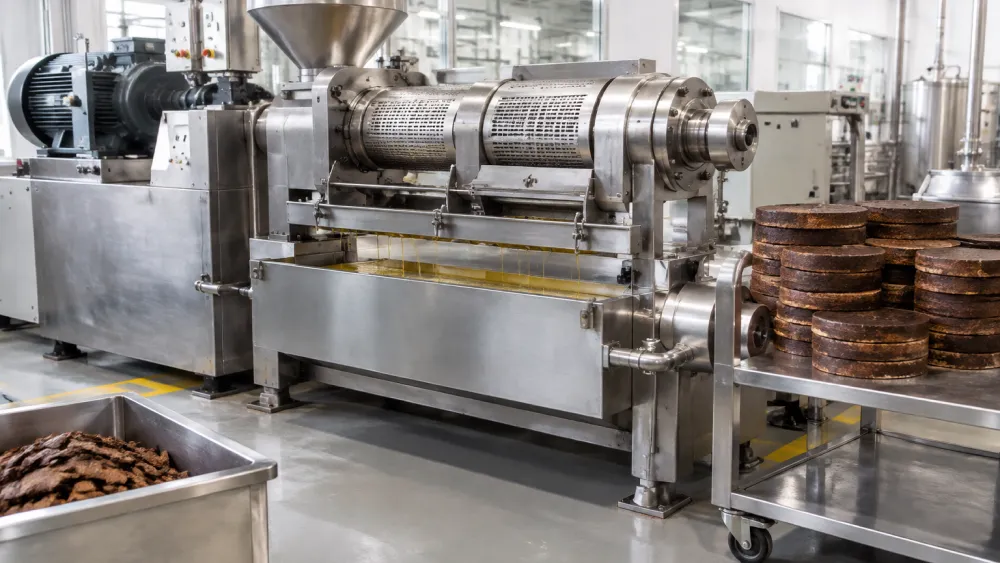
The liquor is pumped hot into horizontal hydraulic presses. The ICCO cites operating pressures of up to 550 bar. Under that pressure the cocoa butter flows out through filter plates and the solids compact into hard discs called press cake. The residual fat in the cake depends on pressing time and process parameters, and producers report a workable range of roughly 10 to 24%. This single stage fixes the fat content of the finished powder, which is why it gets its own section below.
7. Cake milling and sifting
The press cake is cooled, broken, and milled, usually with hammer or disc mills working together with an air classifier. The classifier returns oversized particles for another pass and lets correctly sized powder through. A common industrial specification is 99% minimum through a 200-mesh sieve, fine enough for smooth mouthfeel and even dispersion in liquids.
8. Tempering, cooling, and packaging
Fresh-milled cocoa powder still holds warm, melted fat between its particles. Left to cool on its own, that fat crystallizes unevenly and the powder cakes and discolors in storage. Producers therefore temper the powder: controlled cooling steps hold it at set temperatures so the residual butter solidifies in a stable crystal form. The result is a free-flowing powder that keeps its color in the bag. The finished product is packed into 25 kg paper bags with inner polyethylene liners at a moisture level of 5.0% or below, then stored cool and dry.
Natural vs alkalized: where the production routes diverge
Both routes share cleaning, roasting, winnowing, grinding, pressing, milling, and packaging. The only structural difference is the alkalization stage. The idea dates to 1828, when Coenraad Johannes van Houten patented both the hydraulic cocoa press and the alkaline treatment; the treatment still carries the name Dutch process in recognition of its origin.
The divergence is small on the flow chart and large in the specification:
| Property | Natural cocoa powder | Alkalized cocoa powder |
|---|---|---|
| pH | 5.0 to 5.8 | 6.0 to 7.8; black grades 8.0 to 9.0 |
| Color | Light to medium brown | Medium brown to jet black |
| Flavor | Sharp, fruity, more acidic | Smoother, rounder, less acidic |
| Dispersibility in liquids | Lower | Higher |
| Typical uses | Baked goods with baking soda, strong cocoa taste | Drinks, ice cream, confectionery, dark-colored products |
Alkali dosage is a flavor decision as much as a color decision. Heavy treatment strips aroma along with acidity. Our own alkalized grades stay below 2% potassium carbonate, which develops color and smoothness without flattening the cocoa character. For the full comparison of the two families, see our guide to natural vs Dutch-process cocoa powder.
How pressing decides the fat content
Fat content is not blended into cocoa powder; it is whatever the press leaves behind. Longer pressing at higher pressure pulls more butter out of the cake. Across the industry the residual fat in press cake runs from about 10% up to 24%, and commercial powders fall into familiar bands: standard grades at 10 to 12%, low-fat grades at 4 to 8%, and high-fat grades around 20 to 24% for applications that need extra body.
The choice has direct consequences in the plant. Fat carries flavor and gives drinks and ice cream their rounded mouthfeel, and it also raises cost, since the butter removed at pressing is the most valuable stream in the factory. Low-fat powders flow and disperse better in dry mixes and hold up in oily systems where free fat would bloom. When you specify a fat level, specify a tolerance with it: a nominal 10 to 12% grade that swings between lots shows up as drift in your finished product. Our article on cocoa powder fat content goes deeper into grade selection.
What process parameters mean for your specification
Production detail matters to a buyer only where it lands on a specification sheet. The main process levers and the values they control:
| Process lever | What it controls | Typical specification |
|---|---|---|
| Alkalization rate | pH and color | Natural 5.0-5.8; alkalized 6.0-7.8; black 8.0-9.0 |
| Roasting profile | Flavor base and color foundation | Set per product target |
| Pressing time and pressure | Fat content | 10-12% standard; 4-8% low-fat; 20-24% high-fat |
| Milling and classification | Fineness | 99% min through 200 mesh |
| Drying and tempering | Moisture and flowability | Moisture 5.0% max |
Numbers on a spec sheet only help when they are verified lot by lot. In our plant every production lot is tested for fat content, moisture, pH, and color value before it ships, and the COA for that lot travels with the order.
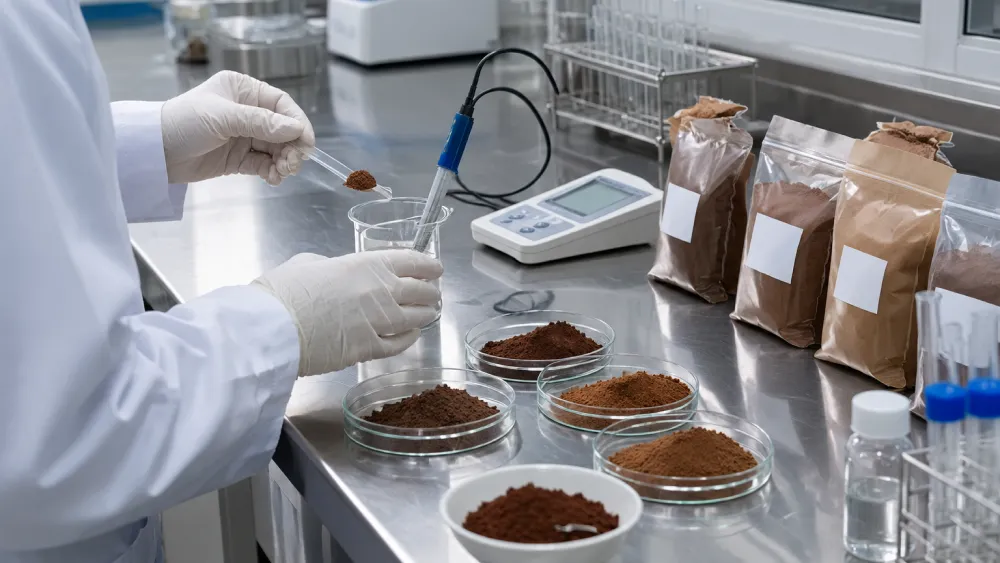
When pH behavior in your recipe matters, the measurement side is covered in our article on cocoa powder pH.
How to evaluate a cocoa powder manufacturer's production line
Equipment brochures tell a buyer very little; two factories with the same machines ship different powder. What you can actually verify before placing a bulk order:
Processor or reseller. A supplier who operates roasting, pressing, and milling controls batch consistency and can adjust specifications. A reseller sources from multiple mills, and quality can drift between shipments.
Lot-level COA. Ask for a certificate of analysis per batch covering fat, moisture, pH, fineness, ash, and microbiology. A generic spec sheet is a different document.
Certifications. FSSC 22000 for the food safety system; Halal and non-GMO where your markets require them.
Traceability. Bean origin and processing history on record from intake to shipment.
Customization. The ability to adjust pH, color, fat, and fineness to your recipe, with a pre-production sample for approval.
Export discipline. Experience with documentation, container loading, and realistic lead times for your region.
Huanda Cocoa operates its own lines in Cambodia, China, and Indonesia under FSSC 22000 and Halal certification, ships 15 to 25 days after order confirmation, and exports to more than 70 countries. The grade structure behind these checks is on our cocoa powder product page.
Source cocoa powder with the process on record
Every property that matters in your plant, color, pH, fat, fineness, moisture, is fixed at a specific stage of production. Buying cocoa powder means buying the discipline of that process. Huanda Cocoa produces 16 grades of natural, alkalized, and black cocoa powder from West African beans, spanning pH 5.0 to 9.0 and fat contents of 10 to 12% and 4 to 8%, with a lot-level COA on every shipment. Tell us your target pH, color, and fat content, and we will match a grade and send a free sample with its specification sheet. Reach the team through the contact page.
FAQ