













Cocoa Butter Substitutes: CBE, CBR, CBS, and Practical Alternatives
There is no single best cocoa butter substitute. For real chocolate, a cocoa butter equivalent (CBE) is usually the closest technical match, while CBR and CBS fats are mainly used in compound coatings; even then, recipe compatibility and local labeling rules still apply. Coconut oil, dairy butter, and shortening can work in some home recipes, but they will change the product’s firmness, flavor, and melting behavior. The right choice therefore depends on the application, the fat’s compatibility with cocoa butter, the tempering process, and how the finished product will be labeled.
What Can You Use as a Cocoa Butter Substitute?
A cocoa butter substitute can mean any fat used instead of cocoa butter in a recipe. In technical purchasing documents, the capitalized term Cocoa Butter Substitute (CBS) also names one specific category of lauric specialty fat. These two usages should not be confused: coconut oil or dairy butter may be a substitute in a home recipe, but that does not make them a formulated CBS for industrial compound coatings.
| Application | Route to evaluate | Main limitation |
|---|---|---|
| Traditional chocolate | Cocoa butter or a permitted CBE | Market-specific composition and labeling rules |
| Compound coatings and molded confectionery | CBR or CBS | Different mouthfeel and limited cocoa butter tolerance |
| Home baking and desserts | Coconut oil, dairy butter, or shortening | Changes in setting, flavor, moisture, and melt |
| Skin care | Kokum, illipe, or cupuaçu butter | Cosmetic specifications do not establish food suitability |
Cost often starts the discussion, and the cocoa butter price drivers explain why buyers review alternatives during volatile markets. Price alone, however, cannot tell you whether a fat will temper, set, release from a mold, or remain stable in the finished product.
Why Is Cocoa Butter Difficult to Replace?
Cocoa butter is the fat pressed from cocoa liquor. Its value in chocolate comes from a combination of physical properties that ordinary cooking oils do not reproduce together.
Melting profile. It remains solid at room temperature and melts close to body temperature, giving chocolate its clean melt-in-the-mouth transition.
Polymorphic crystallization. It can form several crystal types. Proper tempering favors the stable Form V crystals associated with gloss and a firm snap.
Structural setting. The crystal network supports molded bars and coatings. Liquid oils cannot provide this structure.
Processing behavior. Cocoa butter affects viscosity, demolding, and the way a coating contracts and sets.
Storage behavior. Fat composition and crystal stability influence fat migration, bloom, texture, and shelf life.
These properties are measurable rather than marketing language. Huanda’s natural, non-deodorized PPP cocoa butter is mechanically pressed without chemical solvents and has a melting point of 32–35°C. When a replacement is proposed, its melting and crystallization behavior needs to be compared with the fat it is intended to replace.
CBE vs CBR vs CBS: How Do Industrial Cocoa Butter Alternatives Differ?
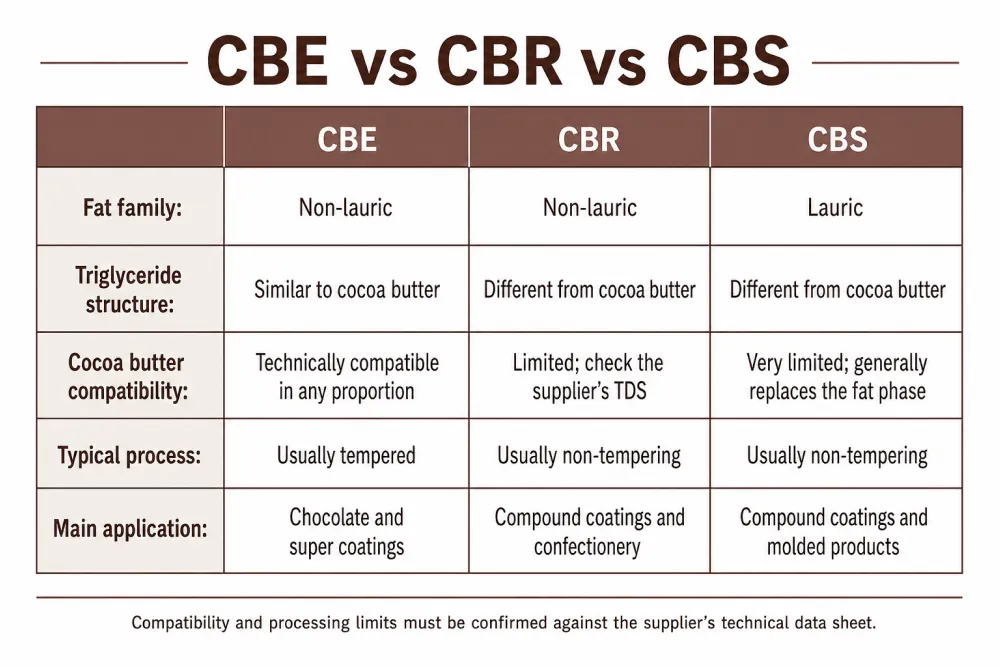
Industrial cocoa butter alternatives are grouped by composition and compatibility. The table gives the conventional classification; the supplier’s technical data sheet remains the controlling reference for any commercial product.
| Type | Composition | Cocoa butter compatibility | Typical process and use |
|---|---|---|---|
| CBE | Non-lauric fats with similar triglyceride structure | Technically compatible in any proportion | Usually tempered; chocolate and super coatings |
| CBR | Non-lauric fats with a different triglyceride structure | Limited; tolerance depends on the product | Usually non-tempering; compound coatings and confectionery |
| CBS | Lauric fats, commonly based on palm kernel or coconut oil | Very limited; generally used to replace the fat phase | Usually non-tempering; compound coatings and molded products |
Cocoa Butter Equivalent (CBE)
CBEs are designed to resemble cocoa butter in triglyceride composition and physical behavior. They can be technically miscible with cocoa butter in any proportion. That compatibility does not create an unlimited legal right to use them in a product sold as chocolate.
Cocoa Butter Replacer (CBR)
CBRs are non-lauric fats with partial cocoa butter compatibility. One supplier may document a tolerance of up to 20% cocoa butter for a particular CBR, but that figure belongs to that product. It should not be copied into another formulation as a universal limit.
Cocoa Butter Substitute (CBS)
CBS fats are lauric systems with very limited cocoa butter tolerance. They are commonly used to replace the fat phase in compound confectionery, where their rapid setting and non-tempering processing can simplify production. Their crystallization and mouthfeel differ from those of tempered cocoa butter.
Which Cocoa Butter Substitute Works for Chocolate and Compound Coatings?
The product name and the eating experience should be decided before the fat is selected. A formulation can produce a chocolate-flavored confection without cocoa butter, but its legal sales name may differ from chocolate.
| Product goal | Fat route | Checks before production |
|---|---|---|
| Chocolate bar or couverture | Cocoa butter, or a CBE where permitted | Tempering, minimum composition, CBE eligibility, and label rules |
| Compound enrobing | CBR or CBS | Cocoa butter tolerance, viscosity, cooling, gloss, and bloom |
| Molded compound confectionery | CBR or CBS | Setting speed, contraction, snap, and mouthfeel |
| Homemade chocolate-style dessert | Coconut oil or another recipe-specific fat | Softness, flavor, storage temperature, and consumer expectations |
Non-tempering does not mean non-crystallizing. Compound fats still set through crystallization, but their stable crystal forms and processing windows differ. A line that works well with cocoa butter may need a different cooling profile after reformulation.
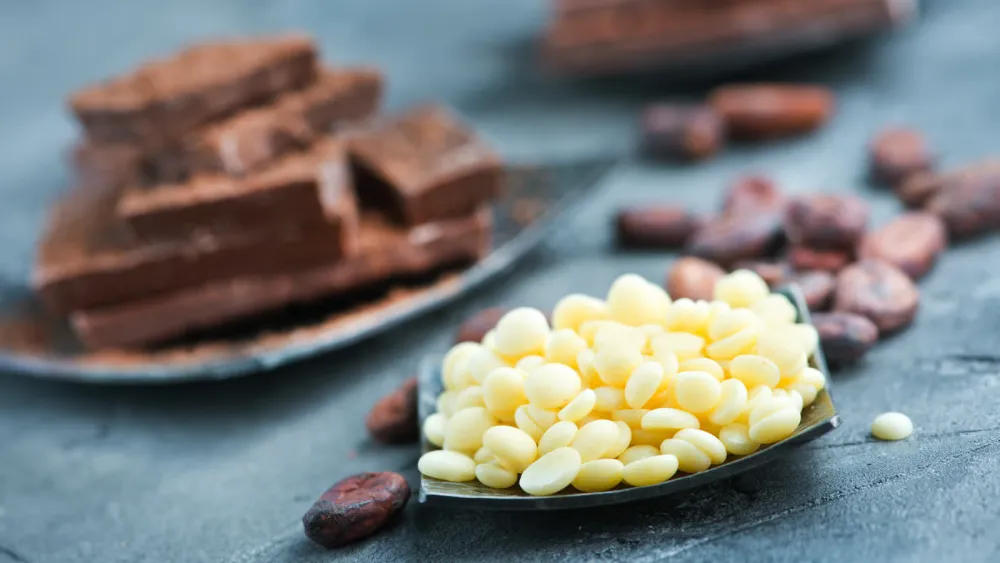
For formulations that require the crystal behavior of cocoa butter, our natural PPP cocoa butter provides a 32–35°C melting point and batch-specific COA documentation. Huanda currently supplies natural, non-deodorized PPP cocoa butter; we do not present CBE, CBR, or CBS as part of that product offering.
Can You Replace Cocoa Butter in Baking and Home Recipes?
Replacement is possible when the recipe does not depend on cocoa butter’s exact crystal structure. The appropriate option changes with the water content, setting requirement, and flavor target.
| Option | Where it may work | What changes |
|---|---|---|
| Coconut oil | Soft homemade chocolates, ganache, and some baked goods | Lower melting behavior and possible coconut flavor |
| Dairy butter | Cookies, brownies, cakes, and buttercream | Adds water and milk solids; softer and unsuitable for tempered chocolate |
| Shortening | Soft coatings and truffles | Less snap and a different melting sensation |
| Liquid vegetable oil | Ganache or limited thinning applications | Cannot build the solid crystal network required for bars |
A universal 1:1 ratio is unreliable. Cocoa butter is almost entirely fat, while dairy butter contains water and milk solids, and liquid oils have no setting structure. Measure by weight, test a small batch, and judge the result at the temperature at which it will be served and stored.
Which Cocoa Butter Substitutes Are Intended for Skin Care?
Skin-care substitution follows hardness, slip, absorption, and melting on contact with skin. It is a separate formulation decision from chocolate production.
| Cosmetic butter | Typical melting point | Formulation effect |
|---|---|---|
| Kokum | 37–40°C | Harder structure for balms and body products |
| Illipe | 37–42°C | Higher melting behavior and added firmness |
| Cupuaçu | 30–35°C | Softer texture that may require adjustment in anhydrous products |
A cosmetic-grade shea, mango, or avocado butter should never be assumed suitable for food. Food recipes require a food-grade ingredient whose supplier has explicitly approved that use, with the corresponding safety and traceability documents.
Can Products Made with Cocoa Butter Substitutes Be Called Chocolate?
Food use and product naming are separate regulatory questions. An alternative fat may be permitted in a food category without being permitted in every standardized chocolate product.
| Market | What the rules say | Practical implication |
|---|---|---|
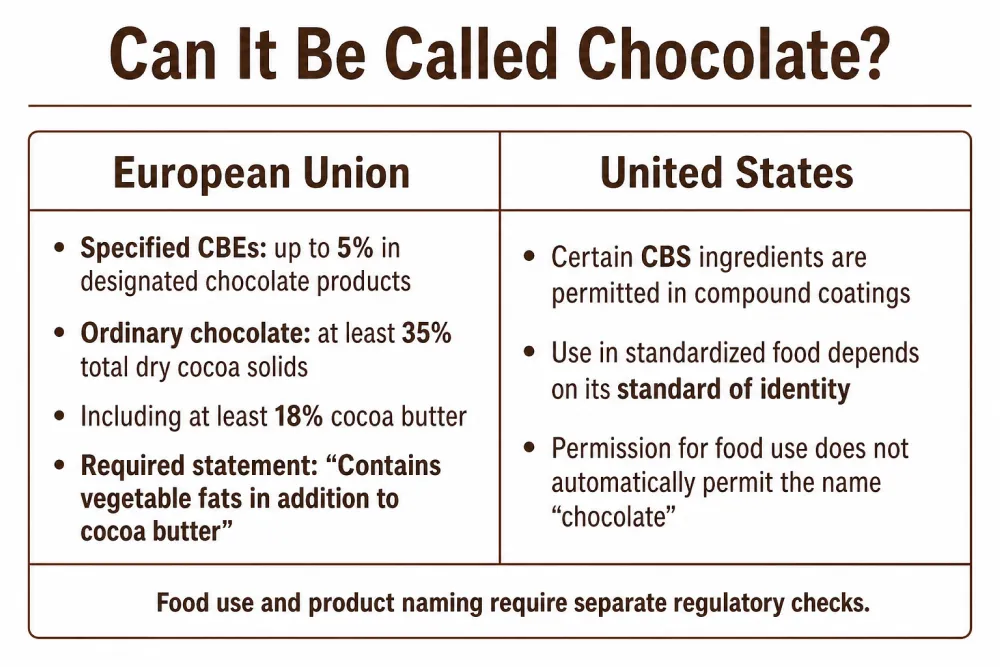
| European Union | Specified CBEs may be used up to 5% in designated chocolate products, without reducing required minimum composition | Check Annex II eligibility, the calculation basis, and the required vegetable-fat statement |
| United States | Certain CBS ingredients are permitted in compound coatings and other listed foods, subject to conditions | A standardized food may use the ingredient only when its standard of identity permits it |
Under EU Directive 2000/36/EC, ordinary chocolate contains at least 35% total dry cocoa solids, including at least 18% cocoa butter and 14% dry non-fat cocoa solids. Article 2 allows specified vegetable fats up to 5% under the defined calculation rules and requires a conspicuous statement that the product contains vegetable fats in addition to cocoa butter.
In the United States, the standards for sweet, milk, and white chocolate list cacao fat and specified optional ingredients rather than a general permission for vegetable-fat substitutes. Separately, 21 CFR 172.861 permits certain coconut- or palm-kernel-derived CBS ingredients in compound coatings and other foods, while explicitly deferring to each standardized food’s standard of identity. Other markets can apply different definitions, so the destination rule should be checked before a formula and label are approved.
What Should Manufacturers Check Before Changing Fats?
A fat change should be treated as a formulation project with documented acceptance criteria. Before approving a substitute, work through this checklist:
Define the product’s sales name and destination market.
Confirm food-grade status, certifications, and the supplier’s intended use.
Review fatty-acid and triglyceride data where relevant to compatibility.
Compare solid fat content, melting behavior, and crystallization conditions.
Obtain the maximum cocoa butter tolerance and processing window from the TDS.
Test tempering or cooling, viscosity, demolding, gloss, snap, and mouthfeel.
Evaluate fat migration, bloom, heat resistance, and shelf life.
Run laboratory and pilot batches before full production, then monitor batch consistency through COA documents.
For cocoa butter itself, useful COA checks include melting point, free fatty acids, peroxide value, and moisture. Huanda tests these parameters batch by batch and can provide the specification sheet and batch COA for evaluation when a formulation requires natural PPP cocoa butter.
FAQ