













Cocoa Butter Price: Market Drivers, Ratios & Sourcing Strategy
Cocoa butter pricing looks simple from the outside. Cocoa beans go up, cocoa butter goes up. Beans go down, butter follows. In practice, the market is more layered — bean price is the anchor, but the ratio to beans, the price of cocoa powder as a co-product, the availability of substitutes like CBE and CBS, and the grinder economics all shape what you actually pay per tonne.
This guide is written for procurement teams and formulation managers who need to make cocoa butter buying decisions in a volatile market. We cover how the price is actually formed, what drove the 2024 spike and 2025–2026 correction, how substitutes affect demand, and what a working sourcing strategy looks like right now.
How Cocoa Butter Is Priced Against the Bean
Cocoa butter is not a stand-alone commodity. It is one of the two main outputs when a grinder presses cocoa liquor — the other being cocoa cake, which becomes cocoa powder. Because both come out of the same pressing run, their prices are quoted as ratios to the underlying bean futures.
The three ratios processors and buyers track:
Cocoa liquor ratio = cocoa liquor price ÷ cocoa bean price
Cocoa butter ratio = cocoa butter price ÷ cocoa bean price
Cocoa powder ratio = cocoa powder price ÷ cocoa bean price
Combined cocoa ratio = butter ratio + powder ratio
When the combined ratio sits above roughly 3.5, grinding is profitable and processors run flat out. When it drops below that level, grinders cut runs or push for higher butter pricing to cover conversion costs. This is why "beans up 20%" does not automatically translate to "butter up 20%" — the co-product economics have to balance first.
In practical terms: cocoa butter typically trades at 2.0–2.5× the bean price in a balanced market, and can push above 3.0× when butter demand is tight relative to powder demand. That multiplier is the single biggest number a buyer should watch.
The PPP Premium: Why Pure Prime Pressed Costs More
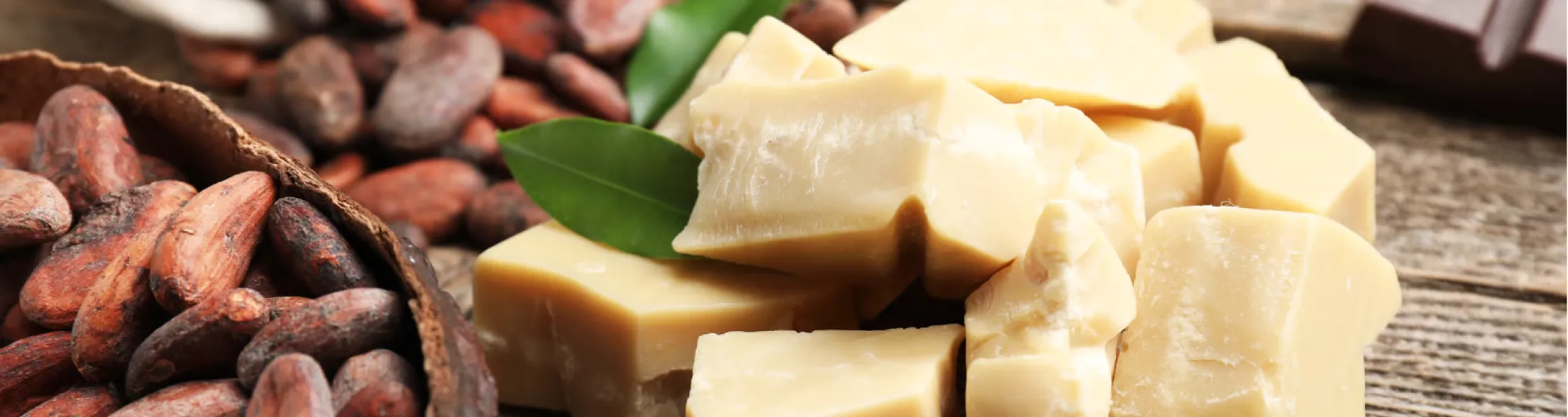
Not all cocoa butter is priced the same. The premium tier is Pure Prime Pressed (PPP) cocoa butter — pressed from clean, first-run cocoa liquor without solvent extraction or blending. PPP holds the natural cocoa flavor, has a tight melting profile (32–35°C, Form V crystallization), and is the standard for premium chocolate and cosmetic-grade applications.
The typical price stack in 2026:
| Cocoa Butter Grade | 2026 Reference Price Band (USD/kg) | Typical Use |
|---|---|---|
| Deodorized / refined (commodity) | $4.5 – $7.8 | Compound coatings, industrial confectionery |
| Natural PPP (food grade) | $6.5 – $9.5 | Premium dark and milk chocolate, couverture |
| Certified organic PPP | $10 – $15 | Clean-label chocolate, organic confectionery |
| Certified sustainable (Rainforest / Fairtrade) | +$0.3 – $0.8 premium | EU markets under EUDR compliance |
The PPP premium exists because the grinder loses flexibility. Pressing PPP requires higher-grade beans, single-origin runs, and cleaner processing lines. Volume yield per bean is also lower than deodorized routes. If you need pure flavor and legal "chocolate" labeling under EU or US regulations, you pay the PPP premium — there is no direct substitute inside the "chocolate" category.
Details on our own PPP production sit on the cocoa butter page.
What CBE, CBS and CBR Do to the Price Ceiling
Cocoa butter has substitutes that are legal in most jurisdictions for products not labeled as "chocolate." These substitutes cap the upside price for commodity-grade cocoa butter in coatings, fillings, and bakery applications:
Cocoa Butter Equivalents (CBE): palm mid-fraction, shea, illipe or mango kernel blends engineered to match cocoa butter's melting curve. Compatible with cocoa butter in any ratio. 2024 market size $1.23B, projected $2.15B by 2033 at a 6.12% CAGR.
Cocoa Butter Substitutes (CBS): lauric-based fats, typically palm kernel derivatives. Cheaper, softer melting point around 30°C, dominant in biscuit fillings and confectionery centers. Held 50.23% of the alternatives market in 2026.
Cocoa Butter Replacers (CBR): partially hydrogenated fats, less compatible with cocoa butter, used mainly in low-cost compound coatings.
The regulatory line: under EU Directive 2000/36/EC, products labeled "chocolate" for retail sale can contain up to 5% vegetable fats from a defined list, but must still meet minimum cocoa solids requirements. US FDA standards of identity are stricter. Compound coatings, chocolate-flavored bakery fillings, and snack coatings can use CBS/CBE without "chocolate" labeling restrictions.
The demand impact: when cocoa butter prices spike, formulators shift borderline applications to CBE and CBS. Once reformulated, most of that volume does not return, even when butter prices drop. This is the structural demand reset that happened after the 2024 crisis.
Historical Price Range and the 2024–2026 Cycle
Cocoa butter had traded in a relatively narrow band from 2016 to 2022 — roughly $4.5–$6.5 per kg for standard refined grades, tracking cocoa bean prices in the $2,000–$3,000/T range.
That framework broke in 2023–2024:
| Period | Cocoa Bean Price | Cocoa Butter Average | Driver |
|---|---|---|---|
| 2022 | ~$2,500/T | ~$5,300/T | Balanced supply |
| 2023 | $3,000 → $4,200/T | ~$6,800/T | West Africa production concerns emerge |
| 2024 | Peak $12,931/T (Dec) | $9,220/T avg, +73% YoY | Black pod, drought, El Niño risk |
| Q1 2025 | $10,000+/T | $9,000+/T | Grinders working through high-cost inventory |
| Q4 2025 | ~$8,000/T | Softening trend | 2025/26 harvest expectations improve |
| Q1 2026 | $6,000–7,000/T | Weakening | Grindings drop 4.2% YoY; European Q1 -7.8% |
| June 2026 | ~$4,900/T | Correction ongoing | Ivory Coast arrivals +18.4%; weather concerns partially offset |
Two features of the 2024–2026 cycle stand out for buyers. First, the butter–bean ratio compressed during the spike — cocoa butter rose less than beans in percentage terms, because grinders needed to keep runs going and demand destruction hit harder on butter than on powder. Second, the ratio recovered during the correction — butter prices held up longer than bean prices as manufacturers refilled positions.
Regional Price Differentials
The reference bean price is set at ICE Futures Europe (London) and ICE Futures US (New York). Physical cocoa butter prices vary by region based on grinder capacity, energy costs, and freight:
West Africa (origin): lowest input costs, but limited PPP-grade capacity. Cost advantage partially offset by farm-gate price interventions in Ghana and Côte d'Ivoire.
Europe (Netherlands, Germany): highest processing quality, tightest tolerances. Energy costs and EUDR compliance push prices $0.3–0.6/kg above origin.
Southeast Asia (Malaysia, Indonesia): largest processing hub for Asian markets. Competitive on volume-grade butter, PPP capacity growing. Freight advantage into Asian buyers.
North America: mostly consumes from Latin American, West African and European supply. Import price sensitivity to freight and FX.
Chocolate Manufacturer Purchasing Strategy: What Actually Works
The cost pass-through timeline for chocolate makers is longer than most buyers assume. Blommer, the largest cocoa processor in North America, has publicly stated that over 85% of its finished product price comes from underlying commodity costs. That means chocolate manufacturers cannot absorb cocoa butter price swings — they either hedge, reformulate, or reset shelf prices.
Effective purchasing strategies in a volatile market:
Lock 60–90 days of coverage at current prices with clear allocation terms. The goal is not to catch the exact bottom. It is to remove headline volatility from your P&L while you decide direction.
Qualify Tier-2 alternates by processing region. Do not rely on a single origin or a single processor. When grinders in one region hit capacity constraints, you need pre-approved backup suppliers ready to activate.
Use combined ratio mechanics in contracts. Reference-priced contracts (bean price × ratio + fixed premium) protect both sides against extreme moves. Fixed-price contracts in a volatile market create winners and losers rather than partnerships.
Reformulate strategically, not defensively. If you have a product line where compound coating is acceptable (snack bar coatings, biscuit fillings), qualify CBE or CBS during high-price periods so you have the option ready. Do not wait until the price forces the switch.
Get EUDR compliance done ahead of the December 30, 2026 deadline. Buyers who need traceability documentation and cannot show geolocation data by the deadline will lose EU market access regardless of price.
For direct-supply relationships, the trade-off is straightforward: working with a manufacturer that controls the full chain from bean to pressed cocoa butter and cocoa liquor gives more predictable batch consistency and simpler ratio-based contracting than dealing through multiple intermediaries. Whether that fits depends on your annual volume and whether you value price transparency over broker convenience.

What to Watch for the Rest of 2026 and Into 2027
Three signals will drive cocoa butter prices over the next 12 months:
West African main crop (September–December 2026). Ivory Coast port arrivals were up 18.4% YoY through late June. If the main crop confirms surplus territory, cocoa butter drops another leg. If weather disrupts pod development, the correction pauses.
European grinding recovery. Q1 2026 grindings hit a 17-year low. When European processors resume normal utilization, demand for cocoa butter tightens and the ratio moves up.
EUDR go-live impact (December 30, 2026). Buyers unprepared for traceability requirements will scramble in Q4. Compliant supply will command a premium. Expect $0.3–0.8/kg spread between compliant and non-compliant cocoa butter into 2027.
Short version: the correction from 2024 highs is real but not linear. Expect butter prices to stabilize in the $5.5–7.5/kg range for standard refined grades through 2026, with PPP holding above $7/kg. Buyers who use this window to lock forward coverage and qualify EUDR-compliant supply will be positioned better than those still chasing the bottom.
FAQ