













Cocoa Butter Melting Point: Temperature Range, Crystal Forms, and Tempering
Quick answer: commercial cocoa butter melts at about 32–35°C (90–95°F), just below body temperature.
This is why chocolate stays solid at room temperature and melts in the mouth.
Published figures range from 31°C to 38°C (Wikipedia, for example, gives 34–38°C) because cocoa butter can set in different crystal structures, butter from different origins is harder or softer, and laboratories measure melting in different ways.
When buying cocoa butter, ask for the melting point together with its test method, the solid fat content at 25°C, and the bean origin.
The sections below explain each point, from the basic melting range to the figures worth checking on a supplier’s specification sheet.
What Is the Melting Point of Cocoa Butter?
Cocoa butter does not melt at one exact temperature. It is a natural blend of several fats, each with a slightly different melting point, so it softens gradually over a few degrees before it turns fully liquid.
| State of the fat | Temperature (°C) | Temperature (°F) |
|---|---|---|
| Hard, brittle solid in storage | 20–25 | 68–77 |
| Begins to soften | about 31 | about 88 |
| Melting range on commercial specifications | 32–35 | 90–95 |
| Fully liquid | 34–38 | 93–100 |
Cacao butter is another name for the same fat, so it melts at the same temperatures.
Suppliers state the commercial range on their specification sheets. Huanda, for example, specifies its natural PPP cocoa butter at 32–35°C and reports the measured value on each batch COA; the PPP cocoa butter specifications list this value with the other quality parameters.
Why Does Cocoa Butter Have Six Different Melting Points?
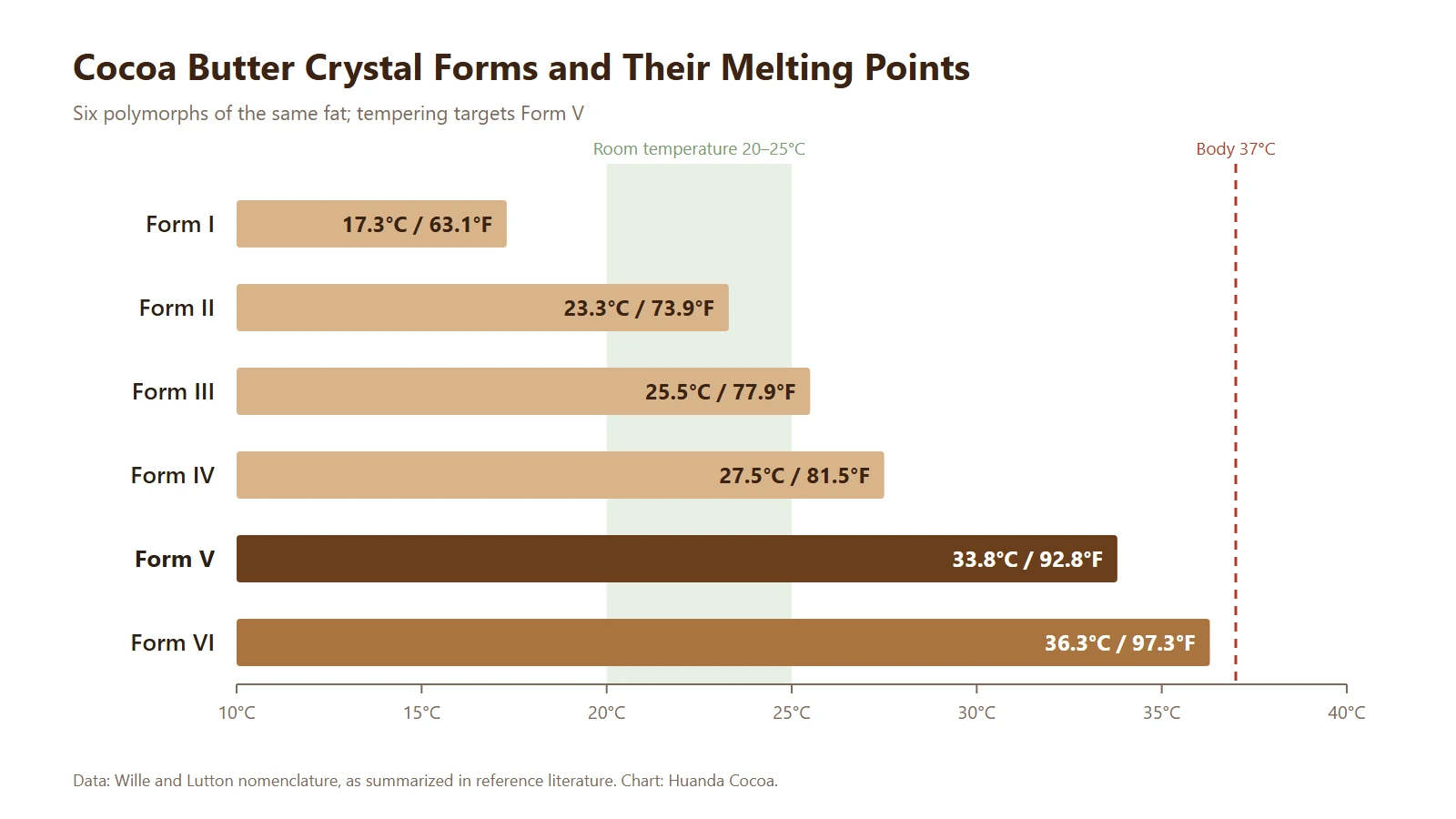
When cocoa butter cools and sets, its fat molecules can stack together in six different ways, called crystal forms I to VI. A loose stack falls apart easily and melts at a low temperature; a tight, orderly stack holds together until it is much warmer. The same cocoa butter can therefore melt anywhere from about 17°C to 36°C, depending on which form it has set in.
| Crystal form | Melts at | What it means for chocolate |
|---|---|---|
| Form I | 17.3°C / 63.1°F | Soft and unstable; forms when liquid fat is chilled very quickly |
| Form II | 23.3°C / 73.9°F | Soft and unstable |
| Form III | 25.5°C / 77.9°F | Soft, with a dull surface |
| Form IV | 27.5°C / 81.5°F | Soft, with a weak snap |
| Form V | 33.8°C / 92.8°F | Glossy surface, clean snap, melts in the mouth: the form chocolate makers want |
| Form VI | 36.3°C / 97.3°F | Develops slowly during long storage; linked to fat bloom, the grey-white film on old chocolate |
Form V is the most stable structure that can be produced directly from melted cocoa butter, and it gives chocolate its shine and snap. The controlled heating and cooling used to obtain it is called tempering, which is explained further below.
Why Do Published Melting Points Disagree?
Crystal forms explain part of the difference between published figures. Some articles even quote "17–36°C", which is simply the range from Form I to Form VI rather than the melting point of commercial cocoa butter. The rest of the difference comes from how melting is measured.
| Test method | What it measures |
|---|---|
| Slip melting point | The temperature at which a column of fat in a thin glass tube softens and starts to slide upward. This is the figure most often printed on specification sheets. |
| Clear point | The temperature at which the fat becomes a completely clear liquid. It reads higher than the slip point. |
| DSC (heat-flow analysis) | How much heat the fat absorbs as it melts. Mainly used in research to identify crystal forms. |
| Solid fat content | The percentage of fat that is still solid at a set temperature, such as 25°C. Used to judge hardness and heat resistance. |
Common reference methods are AOCS Cc 3-25 for the slip melting point and AOCS Cd 16b-93 for solid fat content.
Sample preparation matters as well. A freshly set sample still contains unstable crystals and melts lower than one that has been held cold long enough to stabilize, so two laboratories testing the same lot can report different values.
No international standard fixes the figure. The Codex Standard for Cocoa Butter (CXS 86-1981) limits free fatty acids to 1.75% but sets no melting point. The value is agreed between buyer and supplier, so the test method should be written into the specification together with the number.
How Does Bean Origin Change Cocoa Butter Hardness and Melting?
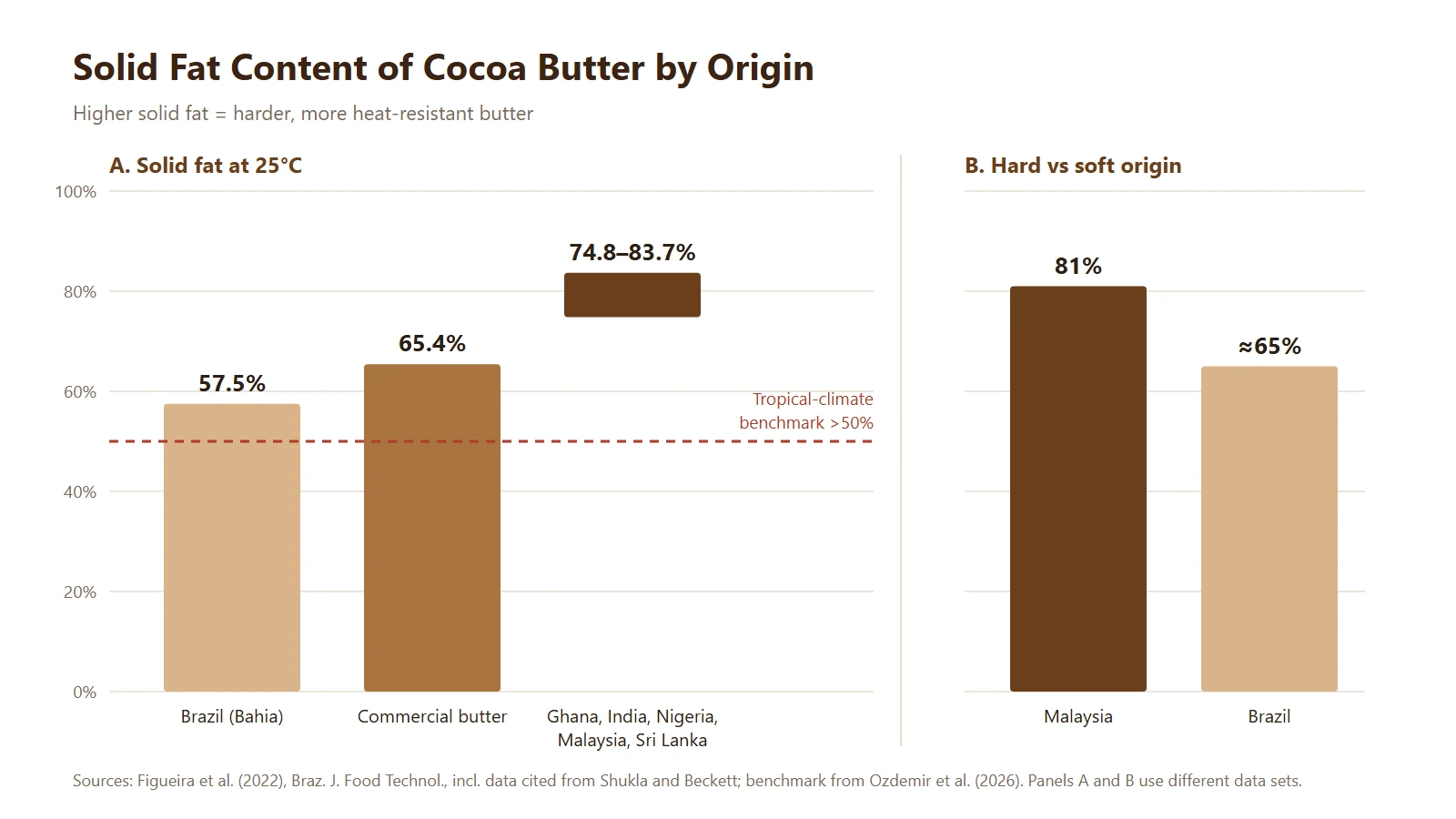
Bean origin changes how hard cocoa butter is. Hardness is usually expressed as solid fat content: the share of the fat that is still solid at a given temperature. A higher figure means harder, more heat-resistant butter.
| Origin | Hardness | Typical use |
|---|---|---|
| Malaysia, Indonesia | Hard | Chocolate sold in hot climates |
| West Africa (Côte d’Ivoire, Ghana) | Medium | Reference profile for most standard recipes |
| Brazil (Bahia) | Soft | Usually blended with harder butter |
The gap between the extremes is large. In a 2022 study of Brazilian cocoa butter, Figueira et al. report 57.5% solid fat at 25°C for Bahia butter, compared with 65.4% for commercial butter and 74.8–83.7% for butters from Ghana, India, Nigeria, Malaysia, and Sri Lanka. Because local butter is softer and less heat resistant, Brazilian chocolate makers import most of their cocoa butter.
Between the main bulk origins, the gap is small. A 2026 preliminary study of cocoa butter from Ghana, Côte d’Ivoire, and Ecuador found no significant difference in solid fat content: all three samples melted completely at 35–36°C, and their main fatty acids differed by no more than 2.5 percentage points.
Huanda presses its PPP cocoa butter from West African beans, mainly from Côte d’Ivoire and Ghana, which gives the medium hardness that most chocolate recipes are built on. For chocolate sold in tropical markets, the same 2026 study cites a benchmark of more than 50% solid fat at 25°C; ask the supplier for this figure and compare it with the cocoa butter in your current recipe.
How Does the Melting Point Set Cocoa Butter Tempering Temperatures?
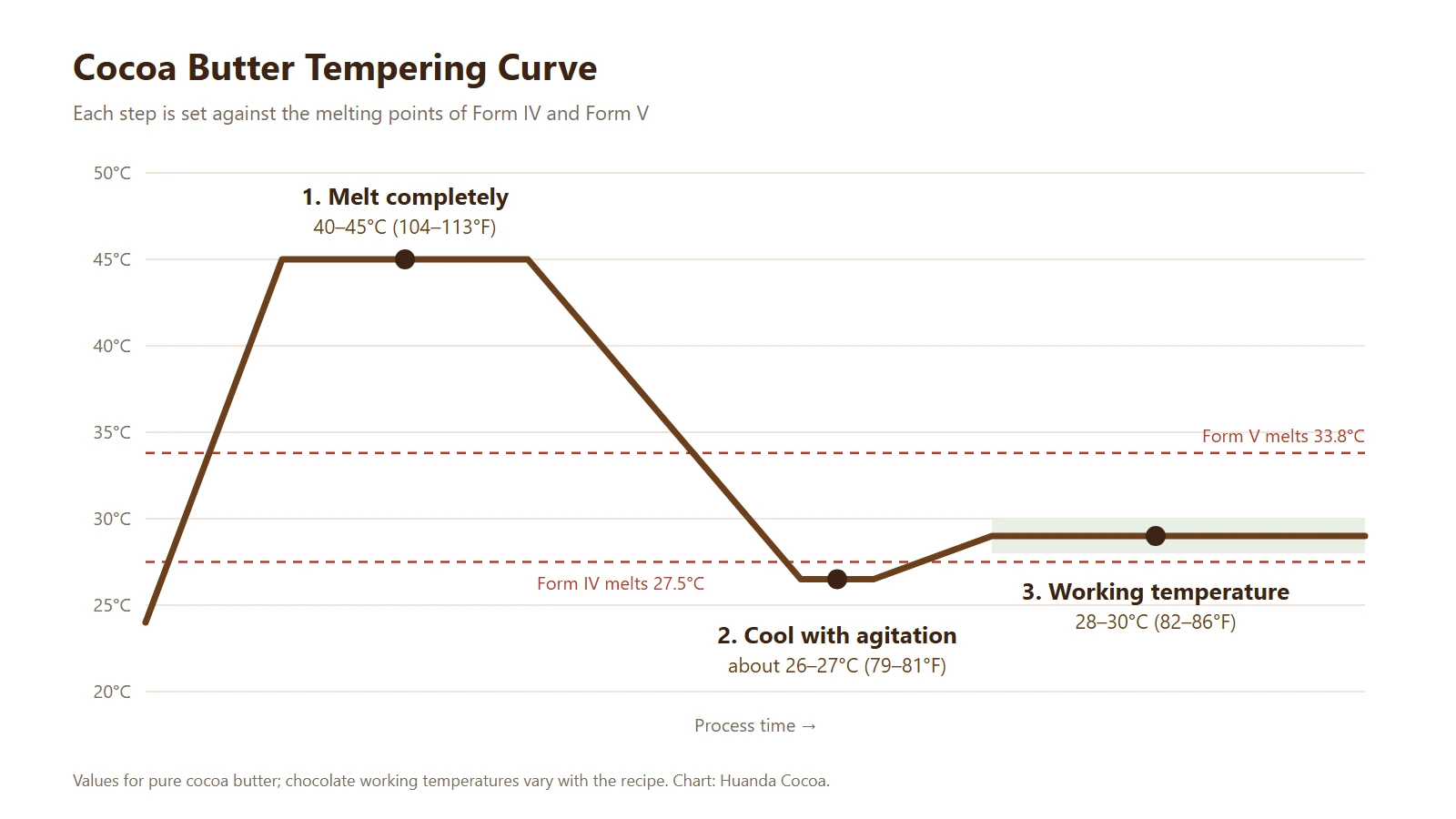
Tempering is the controlled heating and cooling that makes cocoa butter set in Form V. Its temperatures come straight from the crystal table above: the working temperature has to sit above the melting point of Form IV (27.5°C) and below that of Form V (33.8°C).
Melt completely at 40–45°C (104–113°F). All existing crystals disappear, so the batch starts as a clean liquid.
Cool while stirring to about 26–27°C (79–81°F). Several crystal forms start to grow, including Form V.
Rewarm to about 28–30°C (82–86°F). The weaker forms melt again, while the Form V crystals survive and guide the rest of the batch as it sets.
Chocolate follows the same steps at slightly different temperatures. In common industrial practice, it is melted at 40–45°C and seeded at around 34°C for dark chocolate or 33°C for milk, white, or colored chocolate. To check the result, spread a thin layer on a clean surface at about 20°C (68°F): well-tempered material sets within about five minutes with a glossy, firm surface, while untempered material stays soft or sets dull and streaked.
How Do You Melt Cocoa Butter Without Damaging It?
Cocoa butter has to be melted before tempering or blending, and careless melting can damage it. The main risks are too much heat, water, and long holding times. The same precautions apply to cacao butter.
Break it into smaller pieces. Large blocks melt unevenly; chopped blocks or drops (pastilles) melt faster and more evenly.
Use gentle, controlled heat. A water-jacketed vessel, warming cabinet, or melting tank set a little above the melting range avoids hot spots. Small samples can be melted in a microwave in 10–15 second bursts, stirring between each one.
Melt it completely before tempering. Partly melted fat keeps leftover crystals of unknown form, which makes tempering unpredictable.
Keep water out. Steam or condensation slowly breaks the fat down and raises its free fatty acids. In chocolate, even a trace of water can make the mass thicken and seize.
Do not keep it hot for long. Long heating makes the fat oxidize and taste stale, which shows up as a higher peroxide value on the COA. Follow the supplier’s technical data sheet for the maximum holding temperature and time.
What Should Buyers Check on a Cocoa Butter Spec Sheet?
A melting point is one line on a specification sheet, and it is only useful together with the information that explains it. Before approving a new cocoa butter supply, check these points:
Melting point and test method. Ask whether the figure is a slip point, clear point, or DSC value. Figures from different methods cannot be compared directly.
Solid fat content. Ask for values at 20, 25, 30, and 35°C. Values below 25°C show how hard the butter is, values between 25 and 35°C show how well it resists heat, and any solid fat left above 35°C can feel waxy in the mouth.
Bean origin. Origin tells you whether the butter is likely to be harder or softer than the one in your current recipe.
Free fatty acids and peroxide value. High free fatty acids mean the fat has started to break down; a high peroxide value means it has started to oxidize. Both can disturb setting. Codex sets a maximum of 1.75% free fatty acids.
Moisture. Low moisture protects the fat during storage and keeps chocolate from thickening during processing.
Batch COA. Check that the COA for each shipment reports the melting point and the other agreed figures.
Storage and transport. Cocoa butter is normally stored below 25°C; shipments to warm destinations need temperature planning so the product arrives solid.
Huanda’s PPP cocoa butter is specified at a 32–35°C melting point, maximum 1.75% free fatty acids, a peroxide value of ≤3.0 meq/kg, and maximum 0.2% moisture, and each batch ships with a COA covering these figures. Alternative fats such as CBS and CBR melt differently; the guide to cocoa butter substitutes explains how. To compare a sample with the butter in your current recipe, request the specification sheet and a batch COA.
FAQ