













Pure Cocoa Powder: How to Verify Purity Before You Buy
Pure cocoa powder appears on quotes, labels and product pages everywhere, yet buyers receive very different products under the same words. Some bags contain only milled cocoa cake. Others contain starch, added sugar or ground shell. For a purchasing manager, "pure" is a claim that needs verification before a container is booked.
The verification path is straightforward once it is broken into levels. Purity can be checked four ways: against the definition behind the claim, against the ingredient list on the label, against the values on the certificate of analysis (COA), and against a few quick tests on a physical sample.
This guide walks through each level. It explains what pure cocoa powder means under international standards, what adulterated products typically contain, which COA indicators confirm purity, and what to ask a supplier before placing an order.
What Does "Pure Cocoa Powder" Actually Mean?
Pure cocoa powder is powder made entirely from cocoa cake, the solid mass that remains after cocoa butter is pressed out of cocoa liquor. It contains no added sugar, milk ingredients, vegetable fats, starches or other fillers. On an ingredient list, it appears as one ingredient: cocoa.
International standards support this definition. Codex Standard CXS 105-1981 defines cocoa powder, fat-reduced cocoa powder and highly fat-reduced cocoa powder as products obtained from cocoa cake that is transformed into powder. The three names differ only in fat content on a dry basis: cocoa powder contains at least 20% cocoa butter, fat-reduced cocoa powder contains 10% to less than 20%, and highly fat-reduced cocoa powder contains less than 10%. Moisture is limited to 7% across the standard.
One point confuses many buyers. Under Codex, the everyday 10-12% "standard" cocoa powder used worldwide is legally classified as fat-reduced. This is a naming convention, not a quality downgrade. A 10-12% powder and a 22-24% powder are equally pure when both come only from cocoa cake. Purity describes composition: what is inside the powder. Fat grade describes how much cocoa butter remains after pressing. The two questions are separate.
When a supplier claims "100% pure cocoa powder," that claim should translate into a single-ingredient declaration and matching laboratory values. If either is missing, the claim is marketing language.
Is Pure Cocoa Powder the Same as Cacao Powder?
In the ingredient trade, the two terms overlap heavily. Where a distinction is drawn, "cacao powder" usually refers to powder milled from beans processed at lower temperatures, while "cocoa powder" refers to powder from roasted beans. Both can be 100% pure, and both can be adulterated. The word on the front of the bag proves nothing; the specification sheet does.
Three points settle most of the confusion:
-
Same origin. Both come from the beans of the Theobroma cacao tree and from the same pressing process.
-
Different processing claims. "Cacao" is commonly marketed as lower-temperature or "raw" processing, with no single legal definition in most markets.
-
Same purity test. Whatever the name, verify composition through the ingredient list and the COA.
For a fuller comparison, see our article on the difference between cacao and cocoa powder.
What Can Be Hidden in Non-Pure Cocoa Powder?
Adulteration has one motive: cost. Cocoa solids are the expensive part of the bag, so cheaper materials are blended in to stretch them. Four methods appear again and again across the industry:
-
Added starches. Corn, wheat or cassava starch adds weight at a fraction of the cost of cocoa. It dilutes flavor and changes how the powder behaves in recipes.
-
Ground cocoa shell. Shell powder adds bulk and fiber and darkens color cheaply. It also pushes ash values well above those of nib-derived powder.
-
Sugar, milk powder or creamer. These turn cocoa powder into a drink mix. The product may be legitimate, but it is a blend and should be priced and labeled as one.
-
Vegetable fats. Cheap oils can imitate the richness of a higher-fat grade while altering melting behavior and flavor release.
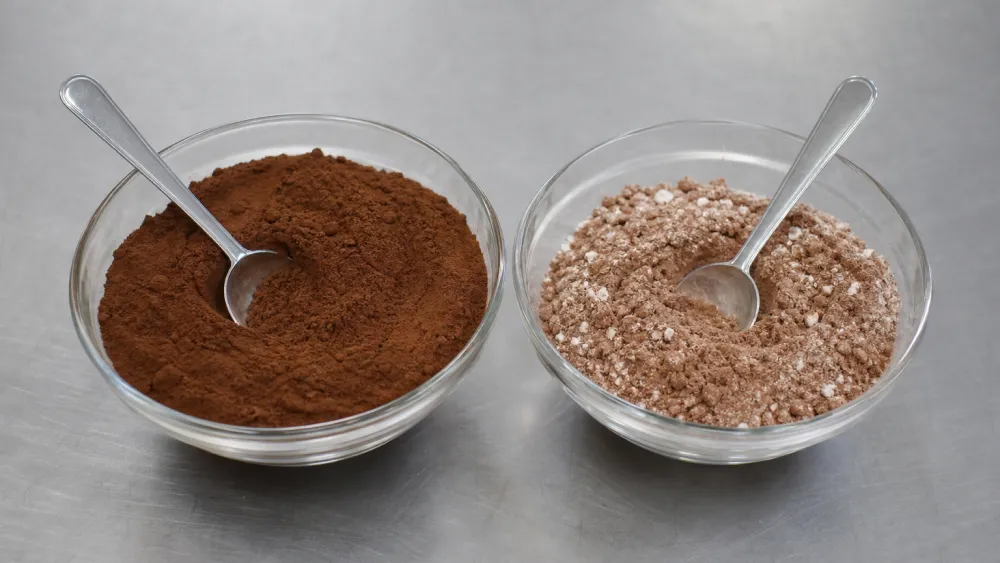
The table below contrasts a genuine product with typical adulterated or blended products.
| Pure cocoa powder | Adulterated or blended product | |
|---|---|---|
| Ingredient list | Cocoa only | Cocoa plus starch, sugar, creamer, shell flour or vegetable oil |
| Aroma and flavor | Strong, clean cocoa aroma; bitter taste | Weak aroma; floury, sweet or off notes |
| Price signal | Quoted in line with the cocoa solids market | Quoted far below market for the claimed grade |
| Typical use | Bakery, beverage, dairy and confectionery formulations | Low-cost instant drink mixes |
| How to verify | COA values within grade ranges; iodine test negative | Abnormal ash or fat values; iodine test turns blue-black |
Low price is the earliest warning sign. When a quote sits well below comparable offers for the same grade, the gap is usually filled with something cheaper than cocoa.
How to Read the Label and Ingredient List?
The ingredient list is the fastest purity filter, and it takes seconds. A pure product declares one ingredient. Any additional entry means the product is a blend, however it is branded.
Red flags that end the "pure" claim immediately: sugar, glucose syrup, milk solids, whey powder, non-dairy creamer, maltodextrin, lecithin, vanillin and vegetable oil. Some of these are acceptable in a flavored product you knowingly buy, but that product should be purchased, priced and specified as a mix.
Two common label phrases deserve clarification. "Unsweetened cocoa powder" indicates no added sugar and normally describes a pure product, but the ingredient list still decides. "Cocoa processed with alkali" describes Dutch-processed powder: the cocoa itself has been alkalized to adjust pH and color, and it remains 100% cocoa. Alkalization is a process applied to the cocoa itself; nothing extra is blended in. For more on that process, see our article on cocoa processed with alkali.
For bulk purchasing, read the ingredient declaration on the specification sheet rather than the retail bag. The spec sheet is a contractual document; front-of-bag claims are not.
Which COA Specifications Prove Purity?
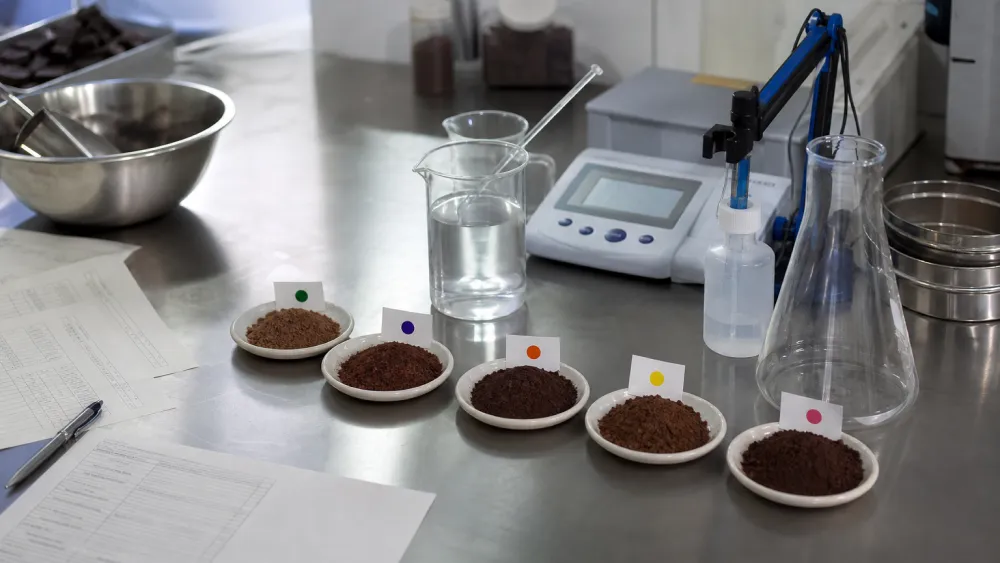
No COA carries a line that says "pure." Purity is proven indirectly, through a set of values that each sit inside the normal range for the declared grade. Six indicators do most of the work.
| Indicator | Typical range for pure powder | What an abnormal result suggests |
|---|---|---|
| Fat content | Declared grade ±1.0%; standard grades are 10-12% or 4-8% | A result far above the declared range may indicate added fat |
| Moisture | ≤5.0% for export-grade powder; Codex allows up to 7% | Excess moisture adds water weight and raises mold risk |
| pH | Natural 5.0-5.8; alkalized 6.0-7.8; black 8.0-9.0 | pH outside the declared process band contradicts the product identity |
| Fineness | 99% min through 200 mesh | Coarse grind can signal shell content or poor milling |
| Ash | Low ash consistent with nib-derived powder for the grade | Elevated ash is a classic flag for added cocoa shell |
| Microbiology | Within limits for total plate count, mold and yeast; Salmonella absent | Failed microbiology indicates poor hygiene or storage, regardless of composition |
Fat content deserves a closer look because it is the most quoted number on any COA. Commercial powders range from about 1% to 24% fat, and specifications carry a tolerance because presses cannot hit an exact figure. A result well above the declared grade, in a powder sold as standard, can mean vegetable oil was blended in to imitate a richer product. For grade definitions and applications, see our article on fat content ranges.
pH works as an identity check. A powder sold as natural should measure between 5.0 and 5.8. If it measures 7.5, either the product was alkalized or the declaration is wrong. Ash works as a shell detector: cocoa shell is far richer in minerals than the nib, so blending shell into powder pushes the ash value upward.
This section covers purity-related indicators only. A full COA review also covers color value, microbiological detail and packaging data, which deserve a separate reading. Our own practice is straightforward: every batch is lab-tested for fat content, moisture, pH and color value before shipment, and COA documents are provided with each order.
What Simple Tests Can Buyers Run?
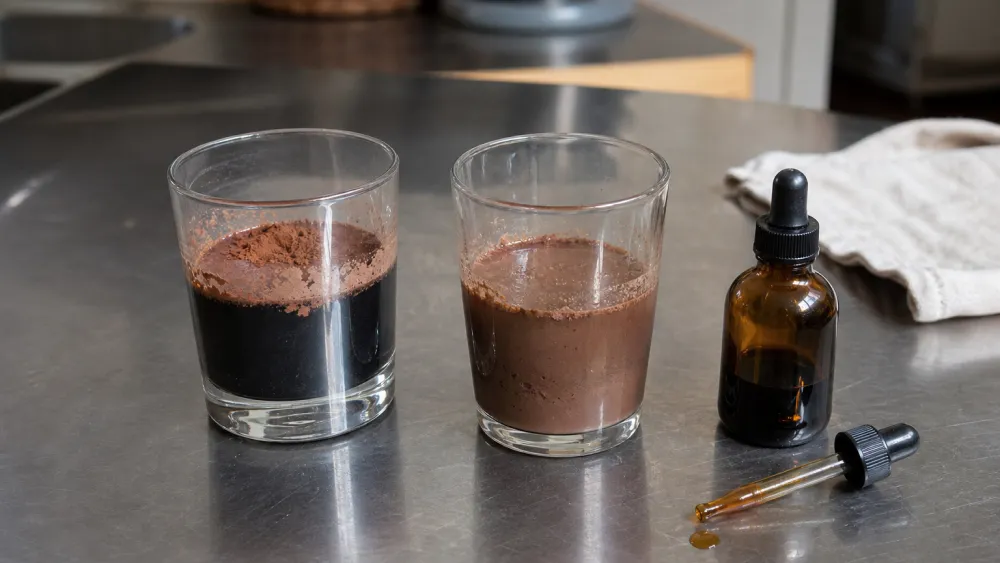
Laboratory analysis gives the final word, but three quick tests on a sample catch most problems before you pay for one. They require a glass of hot water, iodine tincture and ten minutes.
-
Iodine test for starch. Stir a spoonful of powder into warm water and let it cool. Add a few drops of iodine solution. A blue-black color indicates starch. Pure cocoa powder shows no change beyond the iodine's own brown tint.
-
Hot water dispersion test. Stir the powder into hot water. Pure cocoa powder disperses without fully dissolving and settles slowly as a fine sediment. A liquid that turns instantly thick and sweet suggests added sugar or creamer. A greasy film on the surface suggests added fat.
-
Aroma and taste check. Smell the dry powder, then taste a small pinch. Pure powder carries a strong cocoa aroma and a clean, bitter taste. Weak aroma, a floury texture or unexpected sweetness points to fillers.
Run these tests on the pre-shipment sample, not on the delivered container. If a sample fails, request the batch COA and a laboratory retest before accepting or rejecting the lot.
What Should You Ask Your Supplier Before Ordering?
Suppliers who sell pure product answer verification questions easily. Five questions cover the essentials:
-
Can you provide a COA for the exact batch before shipment? A generic spec sheet describes a product line; a batch COA describes what you will actually receive.
-
Which food safety certifications does the factory hold? Recognized schemes such as FSSC 22000, plus Halal, Kosher or Non-GMO certification where your market requires them, show that quality systems are audited externally.
-
Where are the beans sourced, and where is the powder produced? Origin and factory location affect flavor profile, supply stability and traceability.
-
What are the full specifications, with tolerances? Fat, moisture, pH and fineness should all carry declared ranges, not single marketing numbers.
-
Can you send a free sample with the spec sheet and COA? A supplier confident in purity has no reason to refuse a testable sample.
Our own answers, as a reference point: Wuxi Huanda Cocoa Food Co., Ltd. operates FSSC 22000 certified factories in Cambodia, China and Indonesia, with Halal, Kosher and Non-GMO certifications. We source beans from West Africa, mainly Côte d'Ivoire and Ghana, and produce 16 cocoa powder varieties exported to more than 62 countries. Packaging is 25 kg kraft paper bags with PE liner, shelf life is 24 months, and the standard minimum order is one 20-foot container, negotiable for first orders. Every batch is lab-tested for fat content, moisture, pH and color value before shipment, with COA documents provided with each order.
The most reliable purity check is a sample you can test yourself. Review our cocoa powder specifications, then request free samples with the spec sheet and batch COA. Run the iodine test, compare the values against the ranges in this guide, and let the powder prove itself before your first order.
FAQ