













Dutch process cocoa powder in a lab dish next to potassium carbonate alkalizing agent
Dutch process cocoa powder—also sold as alkalized cocoa, Dutched cocoa, or European-style cocoa—is cocoa powder that has been treated with a food-grade alkali, most often potassium carbonate, to raise its pH from a natural 5.0–5.8 to roughly 6.8–8.1. The treatment darkens the powder, rounds off acidity and bitterness, and improves how it disperses in liquids. That combination is why most industrial chocolate-flavored products, from sandwich cookies to ready-to-drink cocoa beverages, are built on alkalized rather than natural cocoa. As a manufacturer running alkalization lines every day, we will walk through what the process actually does, how the main grades differ, and what to verify before you place a bulk order.
What Is Dutch Process Cocoa Powder?
All cocoa powder starts the same way. Fermented, dried cocoa beans are cleaned, roasted, and ground into cocoa liquor. The liquor is pressed to separate cocoa butter from the solid cake, and the cake is milled into powder. Natural cocoa powder skips any alkali treatment and keeps the bean’s native pH of about 5.0 to 5.8. Dutch process cocoa adds one step: an alkaline solution is applied, usually to the nibs before roasting, which neutralizes part of that acidity and drives color and flavor changes during heating.
In one sentence: Dutch process cocoa powder is the same thing as alkalized cocoa powder—the two terms describe one product, and the degree of alkalization (light, medium, heavy, or black) determines its final pH, color, and flavor.
Why It Is Called “Dutch”
The name comes from the Netherlands in the early 19th century. Casparus van Houten patented a hydraulic press around 1828 that removed most of the cocoa butter from ground beans, producing the first practical cocoa cake. His son, Coenraad Johannes van Houten, then developed the alkali treatment that made the resulting powder milder and easier to mix with water. Together, the two inventions created cocoa powder as a commercial product, and “Dutching” became industry shorthand for alkalization. Nearly two hundred years later the chemistry is far better controlled, but the principle has not changed.
How the Alkalization Process Works
Alkalizing Agents
Potassium carbonate (K2CO3) is the standard agent because it gives clean, predictable color development and is easy to dose. Sodium carbonate, potassium hydroxide, and magnesium oxide are also permitted in most markets. In the United States, alkalized cocoa is regulated under FDA 21 CFR 163.110; the EU and Codex Alimentarius set comparable limits. Typical dosage runs from about 1% to 3% alkali relative to cocoa mass, depending on the target pH.
Where the Alkali Is Applied
Alkalization can happen at three points: on the nibs, on the liquor, or on the pressed cake. Nib alkalization is the most common route in dedicated cocoa powder plants because the porous nib absorbs the solution evenly, producing uniform color through the whole particle instead of only on the surface. In practice, the nibs are mixed with the alkali solution, then held at 80–110°C with controlled moisture and pressure; some color-focused processes also inject air to push oxidation further. After the reaction, the nibs are dried, roasted, ground into liquor, and pressed, and the cake is pulverized and stabilized into finished powder.
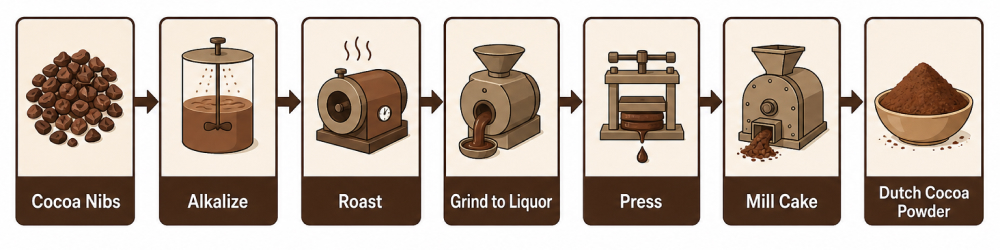
The degree of alkalization is set by five variables: alkali type, dosage, temperature, reaction time, and moisture or oxygen level. Small shifts in any of them move the final pH and the L*a*b* color values, which is why batch-to-batch process control matters more for alkalized powder than for natural.
pH, Color, and Flavor: The Practical Differences
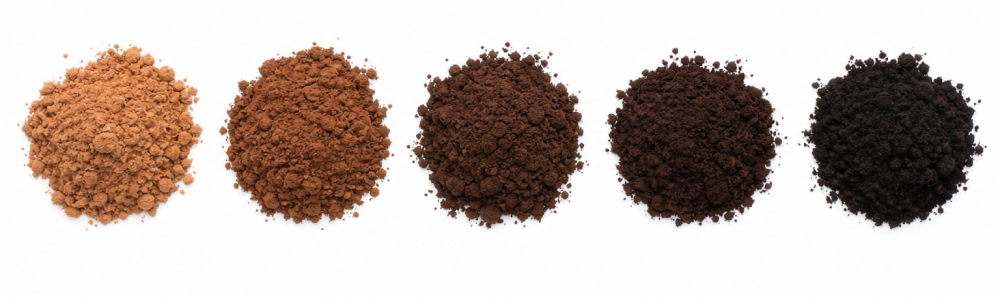
The table below shows how the alkalization level maps to measurable specifications and sensory character. Exact pH bands vary slightly between producers, but these ranges are widely used in B2B trade.
| Typical pH | Color | Flavor profile | Common applications | |
|---|---|---|---|---|
| Natural | 5.0–5.8 | Light brown | Sharp, fruity, acidic cocoa notes | Baking-soda recipes, flavanol-focused products |
| Light alkalized | 6.8–7.2 | Brown to red-brown | Balanced, classic cocoa | General bakery, beverages |
| Medium alkalized | 7.2–7.6 | Dark red-brown | Rounded, mild, low acidity | Ice cream, dairy drinks, coatings |
| Heavy alkalized | 7.6–8.2 | Very dark brown | Strong cocoa impact, minimal sharpness | Dark bakery goods, premium beverages |
| Black | 8.0–9.0 | Near black | Earthy, smooth, very low bitterness | Sandwich cookies, color-driven formulas |
Two changes deserve emphasis. First, color: alkaline conditions accelerate the browning and polymerization of cocoa polyphenols, shifting the powder from light brown toward red, then dark brown, then nearly black. Second, dispersibility: alkalized powder wets and suspends in liquids more readily than natural cocoa, which is a real production advantage in beverage and dairy lines.
Dutch Process vs Natural Cocoa in Formulation
The main functional difference is acidity, and it matters most when chemical leavening is involved. Natural cocoa is acidic and reacts with baking soda to release carbon dioxide; many traditional American recipes rely on exactly that reaction. Dutch process cocoa is close to neutral, so it contributes little or no acid—formulas built on it typically use baking powder, which carries its own acid. Swapping one for the other without adjusting the leavening can leave a cake flat or give it a soapy off-note from unreacted soda.
In recipes without chemical leavening—sauces, ice cream, hot chocolate, fillings, frostings—the choice comes down to color and flavor, and the two types can be interchanged freely. For a full side-by-side comparison, see our guide on natural vs Dutch process cocoa powder.
Where Dutch Cocoa Powder Is Used
•Bakery: cakes, brownies, and cookies gain deeper color and a milder cocoa note at the same or lower dosage.
•Beverages: instant cocoa mixes and ready-to-drink lines depend on the superior wettability of alkalized powder.
•Ice cream and dairy: a near-neutral pH is friendlier to milk proteins, which reduces stability problems in chocolate milk and dairy desserts.
•Confectionery and coatings: compound coatings, fillings, and syrups use medium to heavy grades for consistent dark color.
•Cereals and snacks: alkalized powder holds its color through extrusion and high-heat processing.
Across these categories the purchasing logic is similar: buyers specify a pH band and a color window, sample two or three candidate grades, then confirm flavor and color in their own application.
Nutrition: What Alkalization Changes
Alkalization reduces flavanols, the antioxidant compounds cocoa is known for. One published analysis found that light Dutching removed around 60% of the native flavanols and heavy Dutching up to 90%, although researchers still debate how much this matters in a normal diet. Caffeine also drops sharply: alkalized powder contains roughly 78 mg per 100 g versus about 230 mg per 100 g in natural powder. Minerals, fiber, protein, and theobromine are largely retained. The practical rule: if flavanol content is the selling point of your product, specify natural or a high-flavanol grade; if flavor, color, and processing performance drive the formula, alkalized is the better tool.
Buying Dutch Process Cocoa Powder in Bulk: What to Check
From the factory side, these are the specification points that prevent most quality disputes:
•pH and alkalization degree stated clearly on the COA, with an agreed tolerance (usually ±0.2).
•Fat content: 10–12% is the standard industrial grade; 20–24% high-fat grades serve premium bakery and ice cream.
•Fineness: at least 99.5% passing a 75 μm (200 mesh) sieve for smooth mouthfeel and even color.
•Color: L*a*b* values with a defined window, not just a verbal description like “dark brown”.
•Moisture: maximum 5% to protect flowability and shelf life.
•Microbiology: total plate count, Enterobacteriaceae, and Salmonella-negative status on every lot.
•Certifications and origin: FSSC 22000, Halal or Kosher where required, plus bean-origin documentation for EUDR compliance in the EU.
•Packaging and shelf life: 25 kg kraft bags with PE inner liner and a 24-month shelf life are the trade standard.
Always test a sample in your own application before committing to volume. Two powders with identical pH can still behave differently, because bean origin and roasting also shape final color and flavor.
Source Alkalized Cocoa Powder Direct from the Factory
Huanda Cocoa operates cocoa processing plants in China, Indonesia, and Cambodia with an annual capacity of 15,000 tons and 16 cocoa powder varieties, covering natural, light, medium, and heavily alkalized through black cocoa. Our lines are FSSC 22000 and Halal certified, and we currently export to 62 countries. If you are qualifying a new supplier, send us your target pH, fat content, and L*a*b* color values—we will match an existing grade or customize one, and provide a free sample with a bulk quotation.
FAQ